L
O
A
D
I
N
G


Zoho, Odoo, ERPNext, Dynamics 365 and custom ERP, delivered by one accountable team.

For telecom contractors, infrastructure vendors and solution providers working on UAE networks, we configure ERP around sites, purchase orders from operators and serialized equipment.
ERP for telecom companies in the UAE serves contractors, tower builders, fibre installers, equipment distributors and connectivity providers rather than licensed operators. Each site is tracked as a task or sub-project under the operator purchase order, with serialized equipment, field crews, subcontract costs and invoicing on acceptance certificates. Zoho One fits small installers; Odoo suits mid-size fibre or tower contractors.
ERP for telecom companies in the UAE is rarely about the licensed operators themselves, which run carrier-grade billing stacks. It is about the businesses around them: fibre and civil contractors laying ducts, tower and rooftop site builders, in-building coverage installers, network equipment distributors, structured cabling firms and managed connectivity providers serving enterprises. Their work arrives as purchase orders against frame agreements, is delivered site by site, and is paid on acceptance certificates.
That model creates a specific accounting problem. A single operator purchase order may cover dozens of sites across Dubai, Abu Dhabi, Sharjah and the Northern Emirates, each with its own materials, crew hours, permits and subcontractor charges. Invoicing usually happens only after site acceptance, so work in progress builds up quickly. Without site-level costing, a contractor can be busy and still lose money on half its sites without noticing until year end.
We implement Zoho, Odoo, ERPNext, Dynamics 365 and custom ERP. For telecom firms the core design is usually project accounting with each site as a task or sub-project, linked to serialized stock and field service. Our project management ERP and field service management pages explain those building blocks in more depth.

These are the patterns we see when site volumes grow faster than back-office systems.
Operators issue large frame POs and release work in batches. Teams lose track of how much of each PO line has been invoiced, leading to rejected invoices or unbilled work.
High-value serialized items move from the store to vans, then to sites, sometimes back again. Without serial tracking, write-offs appear only at stock count.
Sites completed months ago may still wait for acceptance documents or photos. Finance needs an aging view of completed but unbilled sites to chase them.
Civil and splicing subcontractors bill per meter, per joint or per site. Without matching claims to completed tasks, duplicate or inflated claims slip through.
Waiting for municipality or building access permits keeps crews idle. When idle time is not recorded against the site, the true cost of delays stays invisible.
This is the sequence we model for most telecom contractors.
One shared database: every step updates stock, finance and reports in real time.
The mix depends on whether you are mainly a contractor, a distributor or a service provider.
Sites as tasks or sub-projects with budgets for labor, materials and subcontract, compared to actuals as work progresses.
Serial and batch tracking across main warehouse, site stores and technician vans, with transfer history.
Work orders assigned to crews with mobile check-in, photos and test results captured on site.
Supplier POs for equipment and subcontract work orders priced per unit of work, matched to completion.
Frame agreements with rate cards, PO line balances and progress or milestone invoicing.
Vans, splicing machines, OTDR testers and ladders tracked with calibration and service dates.
Work in progress, retention, multi-entity books and VAT reporting in one ledger.
Technician records, overtime, site allowances and WPS salary files.
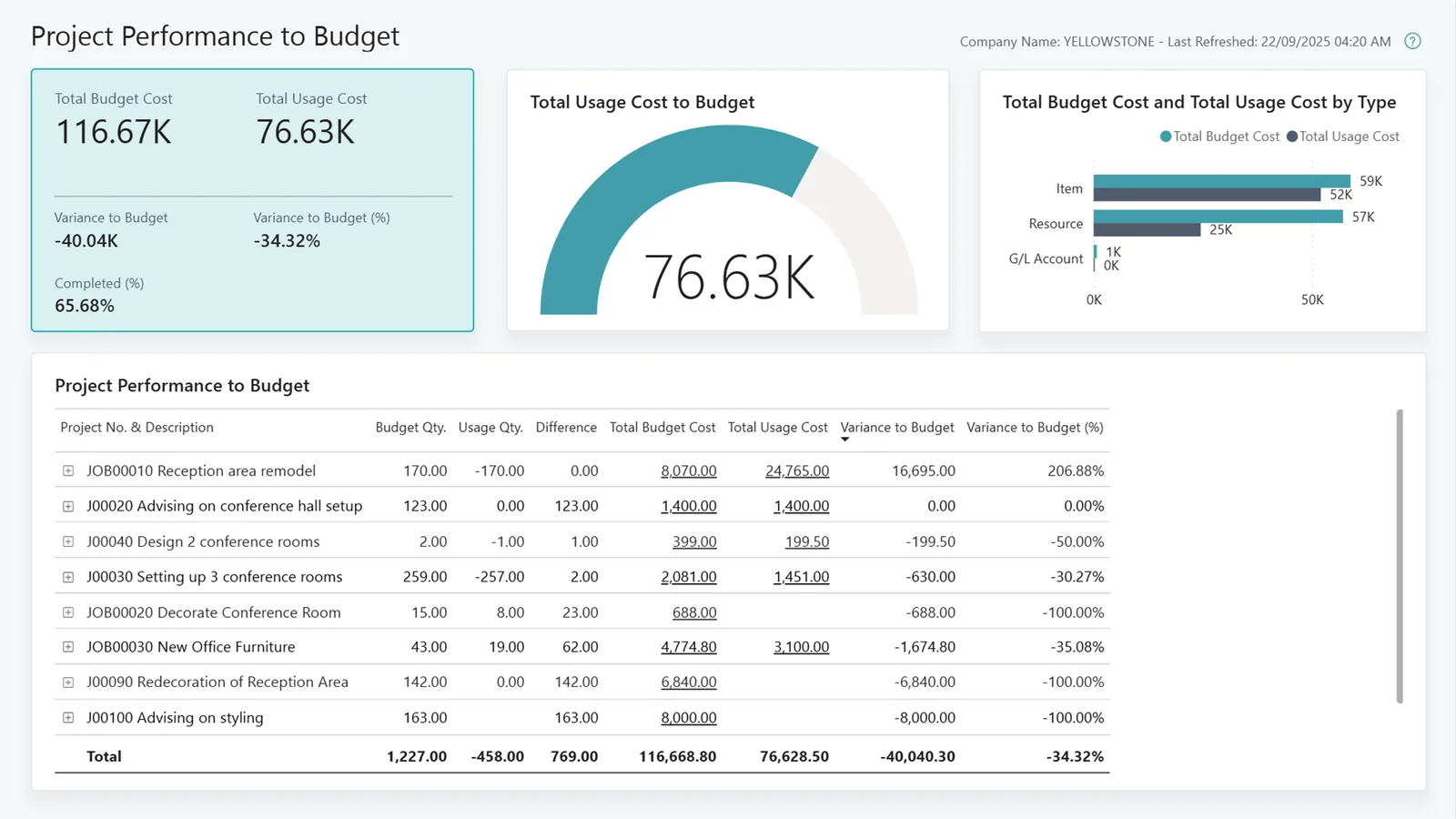
A single screen shows where each site stands and what it has cost so far.
Each of these can work; the table shows where each tends to fit best.
| Company profile | Often a good fit | Why |
|---|---|---|
| Small cabling or installation contractor | Zoho One (Projects, Books, Inventory, FSM) | Affordable, quick to deploy and simple for technicians on mobile. |
| Mid-size fibre or tower contractor with many sites | Odoo (Project, Field Service, Inventory, Accounting) | Site tasks, serial tracking and field service work orders share one database. |
| Equipment distributor with serialized stock | ERPNext or Odoo | Strong serial and batch tracking with warranty records and multi-warehouse stock. |
| Regional group with several entities and strict audit | Dynamics 365 Business Central | Jobs, dimensions and consolidation suit multi-company reporting to head office. |
| Unique operator portal or rate-card logic | Custom ERP or extension | Custom modules can mirror operator workflows where packaged tools fall short. |
We configure ERP to support these requirements. Confirm the treatment of your contracts with your tax advisor.
Tax invoices need your TRN and the prescribed fields at 5%. Progress and milestone invoices must carry correct tax point handling, which the billing setup should enforce.
Telecom equipment sold or installed in the UAE may require TDRA type approval. The ERP can store approval references against item records so sales and procurement can check them.
B2B invoices to operators and enterprises will move to PINT AE through an Accredited Service Provider from 2027, with dates depending on revenue. Check the latest Ministry of Finance and FTA guidance.
Field crews often have overtime and site allowances. Payroll should calculate these and produce the Salary Information File for WPS, with gratuity accrued under UAE Labour Law.
General information, not tax or legal advice. Rules change; confirm current FTA, MOHRE and Ministry of Finance guidance with your advisor.
These are the outcomes we design toward; actual results depend on data quality and adoption.
Accepted sites trigger invoice drafts against the right PO line, reducing the gap between work done and cash.
Serial tracking to site level shows where every high-value unit is and who last handled it.
Labor, materials, subcontract and idle time recorded against each site reveal which work is profitable.
Claims are matched to completed tasks before approval, cutting disputes and duplicate payments.
Indicative ranges; larger rollouts with several entities take longer.
Durations are typical ranges; your plan is agreed after discovery.
Review operator contracts, rate cards, site lifecycle and current stock control.
Define site structure, serial rules, subcontract pricing and invoice formats per operator.
Set up projects, field service app, warehouses, van locations and reports.
Load open POs with balances, active sites, serialized stock and open subcontractor claims.
Train storekeepers, site engineers and finance, then go live region by region if needed.
Platforms, modules and services that support telecom contractors and distributors.
We configure the system for the rules UAE businesses report against, and test it before go-live.
General information, not tax or legal advice. Confirm current requirements with the FTA, MOHRE or your advisor. See all UAE compliance guides.
On-site workshops in Dubai, Abu Dhabi and Sharjah, and remote or on-site delivery across the Northern Emirates and free zones.
Official sources and references
Facts on this page were checked against these sources in October 2026. Rules change, so confirm current requirements before acting.
Yes. We usually model the PO as a project or contract with sites as tasks or sub-projects. Each site carries its own budget and costs while the PO shows invoiced and remaining value per line.
Through the mobile app of the chosen platform, scanning barcodes on the equipment. The serial moves from van stock to the site and is linked to the work order for warranty and audit.
Invoice templates can be adjusted to include PO numbers, site IDs and acceptance references. From 2027 the structured e-invoice through your ASP will also need to carry the required data fields.
Yes. Recurring billing can run alongside project billing in the same ledger, so managed connectivity and installation revenue are reported separately.
Where the portal offers an API or structured file exchange we can integrate. Many portals only allow manual uploads, in which case we generate the files or documents your team needs to submit.
Zoho or ERPNext usually have the lowest entry cost for small teams. The better question is which one fits your site and stock process, which we assess in discovery before recommending anything.
Related Solutions
Related Industries
Related ERP Platforms
Share a sample operator PO and site list, and we will show how it would run end to end in an ERP.
Dubai, United Arab Emirates