L
O
A
D
I
N
G


Zoho, Odoo, ERPNext, Dynamics 365 and custom ERP, delivered by one accountable team.

Odoo has no single construction app, so the result depends on how Project, Purchase, Inventory and Accounting are joined together. We configure them around your jobs, BOQs and payment certificates.
Odoo can work for UAE construction companies, but it has no single construction app, so results depend on joining Project, Purchase, Inventory and Accounting around each job. Every project gets its own analytic account, so purchases, timesheets, site stock issues and invoices feed a live budget-versus-actual view. Gaps such as retention on progress claims or variation orders need configuration or a small custom module.
Odoo for construction companies in the UAE works best when you treat it honestly: it is a flexible ERP with strong project, purchasing and accounting apps, not a ready-made contractor package. There is no standard BOQ module, no built-in retention ledger and no payment certificate screen out of the box. What Odoo does offer is analytic accounting, project tasks, timesheets, site stock locations and milestone invoicing, which together can carry a construction cost model once they are set up with care.
For a fit-out company in Al Quoz, an MEP subcontractor in Sharjah or a civil contractor working on Abu Dhabi infrastructure, the core question is the same: are we making money on this job, and will we know before it is too late? In Odoo, each project gets its own analytic account. Every purchase order, vendor bill, timesheet entry, stock issue and customer invoice tagged to that job flows into a live budget-versus-actual view.
Where the standard apps stop, we add light configuration or a small custom module, for example for retention on progress claims or variation orders. We explain those gaps at the start so there are no surprises. If you are still comparing platforms, our construction ERP buying guide sets out the options side by side.
The products we configure, integrate and support on projects like this one.
 Odoo Invoicing / Accounting
 Odoo Sales
 Odoo CRM
 Odoo Inventory
 Odoo Purchase
 Odoo Manufacturing
Product names and logos are trademarks of their respective owners and are shown only to identify the software we implement.
These are the issues UAE contractors raise most often in the first workshop.
Material, labor and subcontract costs are collected after the project closes. By then any overrun is already locked in.
Site engineers buy urgent material with petty cash or verbal orders. Those costs reach the job ledger late or land on the wrong project.
Interim payment applications are prepared from spreadsheets, with retention and advance recovery calculated by hand. Errors delay certification and cash.
Signed subcontracts and their running bills are tracked separately from the project budget, so committed cost is unknown.
Workers move between sites, but timesheets are kept by camp or foreman. Labor cost per project becomes an estimate.
Owned machinery and hired equipment move between projects without a record of use, so costs are not recharged.
This is the flow we build for most contracting clients. Each step carries the project's analytic account so costs never lose their job reference.
One shared database: every step updates stock, finance and reports in real time.
No single app covers construction. These are the pieces we combine, with notes on where configuration or a custom module is needed.
Each contract becomes a project with stages, tasks for work packages and a link to its analytic account for cost tracking.
Budgets by project and cost code, such as concrete, steel, MEP or labor, compared with actual costs in real time.
Material requests from site, RFQs to several suppliers, purchase approvals by value and subcontract orders tied to the job.
A stock location per site, so material issued to a project is costed against it and leftover stock can be returned or transferred.
Foremen log crew hours by project, and planners assign labor across sites for the coming week.
Milestone or percentage-based invoicing for progress claims. Retention and advance recovery usually need extra configuration or a small module.
Service schedules for plant and vehicles, with usage logged so equipment costs can be recharged to jobs.
Drawings, method statements, subcontracts and handover documents stored per project and signed electronically.
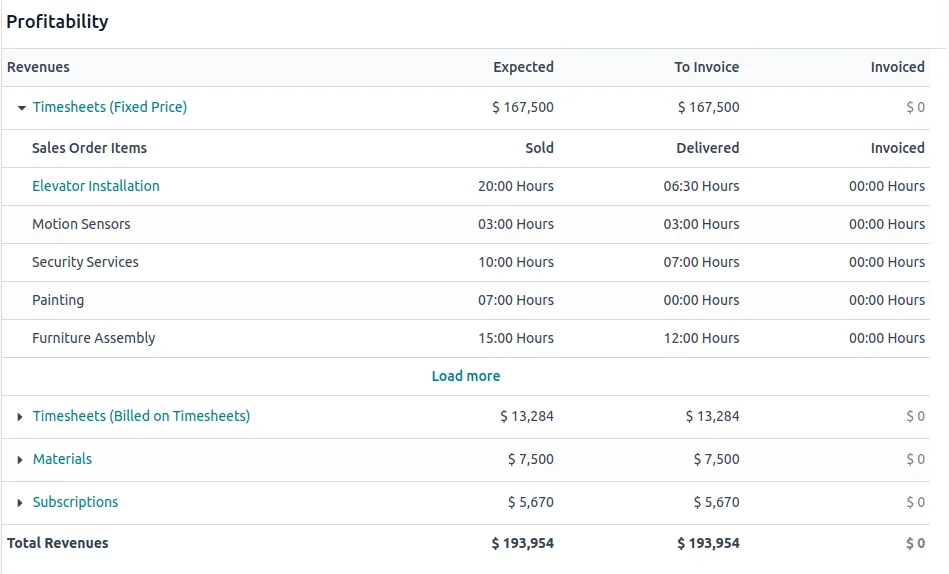
Project managers and the commercial team share one view of each job, built on Odoo analytic reports and project data.
Construction contracts raise specific VAT and payroll questions. We configure Odoo to record the right data; treatment should be confirmed with your tax advisor.
VAT on construction contracts is generally due on the earlier of the payment date or invoice date for each stage. Odoo issues a tax invoice per progress claim with your TRN and the 5% VAT amount shown.
Retention amounts raise a timing question for VAT. We keep retention on a separate account and line so your advisor can confirm when VAT applies to the retained portion.
Contractors often have large labor forces paid through MOHRE's Wage Protection System. Odoo payroll can hold salary structures, overtime and allowances and prepare data for the SIF your bank or exchange house requires.
Progress invoices to developers and main contractors are business to business, so PINT AE e-invoicing through an Accredited Service Provider will apply, from 1 January 2027 or 1 July 2027 depending on revenue. Check the latest Ministry of Finance and FTA guidance.
General information, not tax or legal advice. Rules change; confirm current FTA, MOHRE and Ministry of Finance guidance with your advisor.
Construction rollouts take longer than trading ones because cost codes, claims and site processes need to be agreed first. These durations are typical, not promised.
Durations are typical ranges; your plan is agreed after discovery.
Agree cost codes, budget format, claim layout, retention rules and approval limits with commercial and finance teams.
Projects, analytic plans, site locations, purchase approvals and invoice templates, plus any small module for retention or variations.
Running projects loaded with budget, committed cost, cost to date, certified value and retention balances.
Separate sessions for site engineers, storekeepers, quantity surveyors and accounts staff.
Support through the first full monthly cycle of material requests, timesheets and progress claims.
Explore construction ERP in more depth, compare platforms, or see the Odoo apps that carry most of the work.
We configure the system for the rules UAE businesses report against, and test it before go-live.
General information, not tax or legal advice. Confirm current requirements with the FTA, MOHRE or your advisor. See all UAE compliance guides.
On-site workshops in Dubai, Abu Dhabi and Sharjah, and remote or on-site delivery across the Northern Emirates and free zones.
Official sources and references
Facts on this page were checked against these sources in October 2026. Rules change, so confirm current requirements before acting.
Still have a question? Our consultants are happy to help.
Ask an ExpertNot in the standard product. Construction setups combine Project, analytic accounting, Purchase, Inventory, Timesheets and Sales. Some community and third-party modules exist, and we review them case by case before recommending any.
Odoo budgets work by analytic account and accounting line, so a BOQ is usually summarized into cost codes for budgeting. If you need line-by-line BOQ quantities tracked against actuals, that is normally a custom module.
Retention can be set up as a separate invoice line posting to a retention receivable account, with a report of balances per project. Automatic retention release on handover usually needs a small customization.
Yes. Odoo runs in a mobile browser and app, so site engineers can create material requests, log timesheets and upload photos from site. Requests then go to the purchasing team for approval.
Not necessarily. Many contractors keep their planning tool for detailed scheduling and use Odoo for cost, purchasing and billing. We can discuss importing key milestones through an integration if needed.
Yes, often more so than for very large contractors, because fit-out jobs are shorter and claims are simpler. A focused setup of Project, Purchase, Inventory and Accounting covers most fit-out needs.
Tell us how your business runs today and where it gets stuck. We'll recommend the right platform, outline the implementation approach and give you a realistic timeline, with no obligation.
Dubai, United Arab Emirates