L
O
A
D
I
N
G


Zoho, Odoo, ERPNext, Dynamics 365 and custom ERP, delivered by one accountable team.

Large UAE groups need ERP that consolidates many entities, enforces governance and connects to dozens of systems. We plan for scale, control and adoption together.
For large UAE groups, Microsoft Dynamics 365 Finance and Supply Chain usually suits complex multinational structures, while Business Central, Odoo Enterprise or ERPNext can suit groups of mid-sized companies. The choice depends on transaction volume, complexity and in-house capability. Enterprise ERP must consolidate mainland, free zone and overseas entities, enforce segregation of duties and connect to HR, treasury, banking and CRM systems.
Choosing ERP software for large enterprises in the UAE starts with the group structure. Many UAE groups combine mainland companies, free zone entities, overseas subsidiaries and joint ventures, often with different currencies, fiscal calendars and reporting lines. The ERP must reflect that structure, consolidate it reliably and give the group CFO one version of the numbers.
At this scale, the harder problems are rarely features. They are segregation of duties, master data ownership, integration with HR, treasury, banking, CRM and industry systems, and getting thousands of users to change how they work. A project that treats ERP as an IT install, rather than an operating model change, tends to overrun.
UAE ERP Experts works with enterprise clients mainly on Microsoft Dynamics 365, and on Odoo and ERPNext for groups that prefer open platforms, supported by custom development where a process is genuinely unique. We also support companies moving off legacy systems through our legacy ERP migration service.

These challenges are specific to groups with many entities, users and connected systems.
Group reporting depends on aligned charts of accounts, intercompany eliminations and currency translation. Without them, consolidation stays in spreadsheets outside the ERP.
The same customer, supplier or item exists under different codes in each subsidiary. Group-level analysis becomes unreliable and procurement loses leverage.
Hundreds of users need precise access. A single role that can create a supplier and approve its payment is an audit finding waiting to happen.
HR, payroll, treasury, banks, CRM, data warehouses and sector systems all exchange data with the ERP. Point-to-point links become fragile without an integration strategy.
Different subsidiaries have different habits and priorities. Without structured change management, local workarounds return within months.
Large businesses face the first wave of UAE e-invoicing and complex corporate tax positions, so compliance work cannot wait for a later phase.
Our enterprise design work centers on control, consistency and scale.
Harmonized chart of accounts, intercompany rules, eliminations and currency translation so group statements come from the system.
Central ownership and approval for customers, suppliers, items and accounts, with shared codes across entities.
Role design that separates duties, with periodic access reviews and logs your internal and external auditors can use.
API-led or middleware-based integration with HR, banks, CRM, BI and industry systems, documented and monitored.
Stakeholder mapping, champion networks in each subsidiary, role-based training and adoption tracking after go-live.
Steering committee, design authority, change control and phased deployment by entity or region.
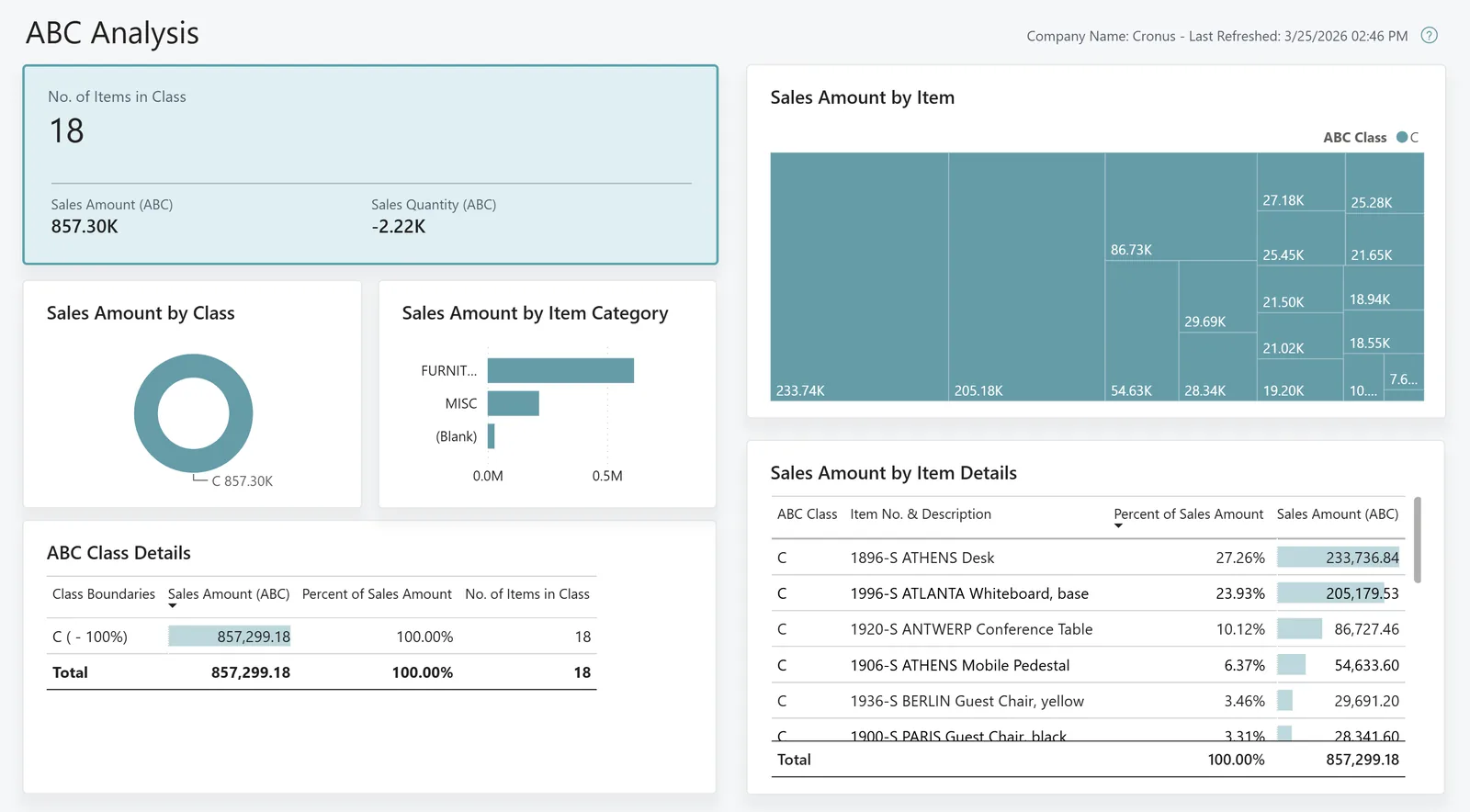
Executives see consolidated performance and can drill down to each entity and business unit.
Enterprise needs vary. This table shows where each option tends to fit.
| Dynamics 365 Finance and SCM | Dynamics 365 Business Central | Odoo Enterprise | ERPNext | Custom ERP | |
|---|---|---|---|---|---|
| Typical enterprise fit | Large multinational groups with complex finance and supply chain | Groups of mid-sized subsidiaries | Groups wanting broad apps on one platform | Groups wanting open-source control | Unique core processes alongside a standard ERP |
| Consolidation | Deep multi-entity finance and consolidation | Consolidation across companies | Multi-company with intercompany rules; group reporting design needed | Multi-company with consolidated financial reports | Built to your rules |
| Security model | Granular roles, duties and privileges | Permission sets per user group | Groups, record rules and access rights | Role permissions and user permissions per document | Defined in the build |
| Integration | Microsoft data platform, APIs and Power Platform | APIs and Power Platform | APIs and connectors | REST API and webhooks | Designed in from the start |
| Watch-out | Long programs and significant budgets | May need extensions for complex scenarios | Scale and performance planning for large volumes | Requires strong technical ownership | Long-term maintenance responsibility |
We do not implement SAP or Oracle. Groups running those systems can work with us on migration or on integrating subsidiaries.
Enterprise timelines vary widely with scope. The ranges below are indicative for a phased program.
Durations are typical ranges; your plan is agreed after discovery.
Group operating model, chart of accounts, master data standards, security model and integration architecture agreed.
One representative entity configured, integrated and tested to prove the template.
Live operation with hypercare, issue tracking and template adjustments.
Remaining entities deployed in waves by region or business line using the proven template.
Access reviews, release management, new integrations and adoption tracking under a governance board.
Large groups face the earliest deadlines and the most complex positions. Always confirm with your tax advisors.
Businesses with revenue of AED 50 million or more must appoint an Accredited Service Provider by 30 October 2026 and issue e-invoices under PINT AE from 1 January 2027. Plan ASP integration per entity and check the latest Ministry of Finance and FTA guidance.
Groups need entity-level taxable income, transfer pricing support data and separation of qualifying free zone income where relevant. MNE group members cannot use Small Business Relief.
ERP structure should match VAT group registrations and handle intra-group supplies correctly.
Large workforces need WPS SIF generation across several employers and banks, plus accurate gratuity provisions under UAE Labour Law.
Change logs, approval history and access reviews support internal audit and external auditors.
General information, not tax or legal advice. Rules change; confirm current FTA, MOHRE and Ministry of Finance guidance with your advisor.
These are the measures a group steering committee typically tracks.
Consolidated statements produced in the system with fewer manual adjustments.
Clear segregation of duties and fewer audit findings on access.
Shared master data across entities for reliable group reporting.
Users across subsidiaries working in the ERP rather than around it.
Explore enterprise platforms, consolidation and migration services.
We configure the system for the rules UAE businesses report against, and test it before go-live.
General information, not tax or legal advice. Confirm current requirements with the FTA, MOHRE or your advisor. See all UAE compliance guides.
On-site workshops in Dubai, Abu Dhabi and Sharjah, and remote or on-site delivery across the Northern Emirates and free zones.
Official sources and references
Facts on this page were checked against these sources in October 2026. Rules change, so confirm current requirements before acting.
Still have a question? Our consultants are happy to help.
Ask an ExpertDynamics 365 Finance and Supply Chain suits complex multinational groups, while Business Central, Odoo or ERPNext can suit groups made up of mid-sized companies. The right answer depends on volume, complexity and in-house capability.
Yes. Each entity is set up as its own company with its own registrations, and the group consolidates them. Free zone income can be tagged to support qualifying income analysis by your advisors.
We build a champion network in each entity, run role-based training and track adoption with usage reports. Local leaders own the change, supported by a central program team.
We do not implement SAP or Oracle. We do help groups migrate selected entities to Dynamics 365, Odoo or ERPNext and integrate subsidiaries with an existing group system.
It depends on the number of entities and integrations. A pilot entity often takes several months, followed by rollout waves. We give a phased plan after the strategy and design phase.
Related Solutions
Related Industries
Related ERP Platforms
Share your group structure and systems landscape, and we will outline a governed, phased ERP program.
Dubai, United Arab Emirates