L
O
A
D
I
N
G


Zoho, Odoo, ERPNext, Dynamics 365 and custom ERP, delivered by one accountable team.

Startups need clean books for investors, simple billing for customers and a system that will not need replacing after the next funding round.
A UAE startup should use a lean ERP setup rather than a full rollout: a structured accounting core connected to subscription billing, payment gateway and bank sync, expense control and payroll, producing investor-ready management accounts. Zoho, Odoo or ERPNext can all serve this role, and a well-structured setup grows from seed to Series B through expansion rather than replacement.
Most founders treat ERP software as something for later. For startups in the UAE, the cost of waiting shows up at the worst moment: during due diligence, when an investor asks for monthly management accounts, a cap table reconciliation, deferred revenue schedules and VAT returns, and the finance data lives across a payment gateway, a bank account and a spreadsheet.
A lean startup ERP is not a large system. It is a well-structured accounting core, connected to how you bill customers, pay suppliers and run payroll, with reports that match what investors expect. Set up properly, it takes little time to run and grows with you from seed to Series B without a painful switch.
Many UAE startups are licensed in free zones such as IFZA, Dubai Silicon Oasis or Dubai Internet City, which brings its own corporate tax questions. We set up the books so your advisor can assess qualifying income and relief options cleanly.

These issues are common in UAE startups that grew faster than their back office.
Investors ask for clean monthly accounts and revenue breakdowns. Rebuilding two years of books under deadline pressure is costly and can delay a round.
Annual plans billed upfront are recorded as revenue on receipt. Metrics such as MRR and deferred revenue become unreliable.
Stripe, Checkout.com or other gateway payouts arrive net of fees and refunds. Without a matching process, receivables and fees are misstated.
Free zone startups may mix qualifying and non-qualifying income without realizing it. Tagging revenue properly is much easier from the start.
A basic invoicing app works for the first customers. It struggles with multi-currency, inventory, payroll or a second entity.
We set up only what a startup needs, with clear routes to add more.
Structured for management accounts, burn rate and runway, with departments or cost centers that match your board pack.
Recurring plans, upgrades, proration and dunning using tools such as Zoho Billing or Odoo Subscriptions, linked to the ledger.
Deferred revenue for annual or prepaid plans released month by month, so MRR and recognized revenue agree.
Payouts, fees and refunds from payment gateways matched automatically against invoices and bank lines.
Receipts captured on mobile, corporate card spend categorized and approvals set by budget owner.
USD, EUR and INR suppliers or customers handled with revaluation, which matters for remote teams and global SaaS sales.
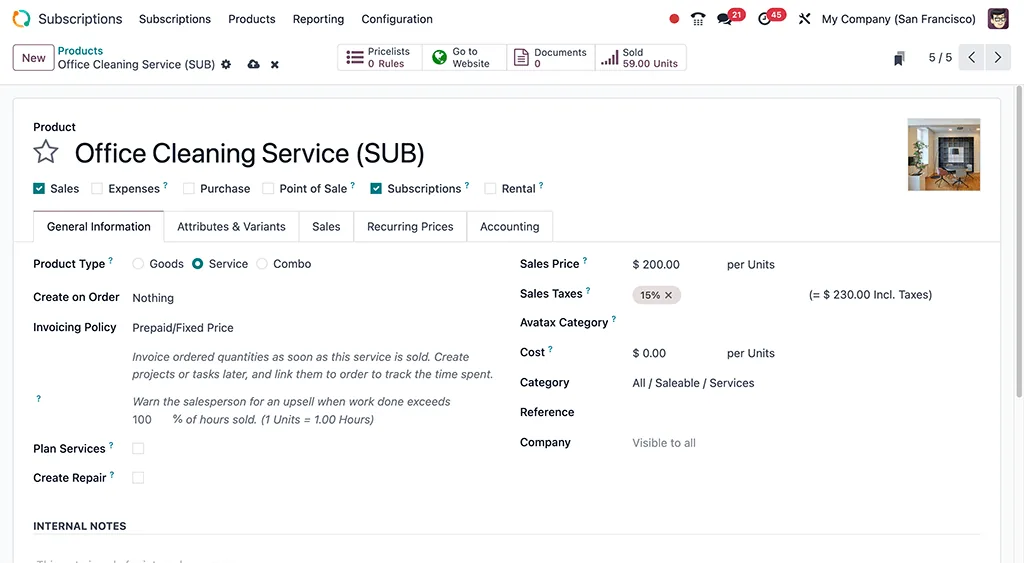
A subscription dashboard that ties product metrics to the ledger.
Each platform can support a startup. The difference is how far it takes you before you need more.
| Zoho (Books, Billing, Zoho One) | Odoo | ERPNext | Business Central | |
|---|---|---|---|---|
| Best stage | Pre-seed to growth | Seed to growth, especially with products or stock | Seed onward with technical founders | Later-stage startups with complex finance |
| Subscription billing | Zoho Billing linked to Zoho Books | Subscriptions app linked to accounting | Subscription documents with recurring invoices | Usually through extensions or connected billing tools |
| Effort to run | Low | Low to moderate | Moderate | Moderate |
| Scaling path | Add CRM, People, Analytics in Zoho One | Add inventory, e-commerce, manufacturing | Full code access for custom workflows | Strong multi-company and audit controls |
| Watch-out | App sprawl if not governed | Install only needed apps | Hosting and updates need an owner | Higher entry cost for a small team |
Startup projects are deliberately short. These are typical ranges.
Durations are typical ranges; your plan is agreed after discovery.
Business model, revenue streams, entities, investor reporting needs and existing tools reviewed.
Chart of accounts, VAT, bank and gateway connections, invoice templates and subscription plans.
Prior months brought into the ERP and reconciled, so the first board pack has comparable history.
Founder or finance hire trained on the monthly close checklist and investor report.
Startups have the same obligations as other companies once they cross the thresholds. Confirm your position with a tax advisor.
Register when taxable supplies exceed AED 375,000 over 12 months, or voluntarily from AED 187,500. Digital services sold to overseas customers may have different treatment, so get advice.
Startups with revenue up to AED 3 million may elect Small Business Relief for periods ending on or before 31 December 2026. It is not available to Qualifying Free Zone Persons or MNE group members.
Free zone startups may access 0% on qualifying income if conditions such as adequate substance and the de minimis rule are met. Clean revenue tagging supports your advisor's review.
Most startups fall under the AED 50 million threshold, with e-invoicing scheduled from 1 July 2027 and ASP appointment by 31 March 2027. Check the latest Ministry of Finance and FTA guidance.
General information, not tax or legal advice. Rules change; confirm current FTA, MOHRE and Ministry of Finance guidance with your advisor.
The benefits show up at board meetings and funding rounds.
Clean, reconciled books ready to share with investors.
MRR, churn and deferred revenue that match the ledger.
Automated reconciliations keep the monthly close small.
The system expands with new entities, staff and products.
Explore subscription tools, free zone guidance and lean platform options.
We configure the system for the rules UAE businesses report against, and test it before go-live.
General information, not tax or legal advice. Confirm current requirements with the FTA, MOHRE or your advisor. See all UAE compliance guides.
On-site workshops in Dubai, Abu Dhabi and Sharjah, and remote or on-site delivery across the Northern Emirates and free zones.
Official sources and references
Facts on this page were checked against these sources in October 2026. Rules change, so confirm current requirements before acting.
Still have a question? Our consultants are happy to help.
Ask an ExpertA full ERP rollout would be. A lean setup with accounting, billing and bank sync is not. It costs little to run and prevents a much larger clean-up before fundraising.
Yes, with the right setup. Annual or prepaid plans are recorded as deferred revenue and released monthly. We configure this in Zoho, Odoo or ERPNext depending on your stack.
It changes how we tag revenue and costs. Your advisor will need to separate qualifying and non-qualifying income, and the ERP can make that analysis straightforward.
Common options include Stripe, PayPal and regional gateways used in the UAE. Connection methods vary by platform, so we confirm during setup.
Usually when you add a second entity, inventory, complex approvals or a sizable finance team. If the first setup is structured well, this is often an expansion rather than a replacement.
Tell us how your business runs today and where it gets stuck. We'll recommend the right platform, outline the implementation approach and give you a realistic timeline, with no obligation.
Dubai, United Arab Emirates