L
O
A
D
I
N
G


Zoho, Odoo, ERPNext, Dynamics 365 and custom ERP, delivered by one accountable team.

We set up ERP for UAE software product and SaaS companies so recurring billing, deferred revenue and engineering costs reconcile without a month-end spreadsheet marathon.
An ERP for software companies in the UAE should generate recurring invoices from plan, seat count and billing cycle, recognise revenue month by month and track deferred revenue. It must also handle mid-term upgrades, collections in AED, USD, SAR and EUR, intercompany charges and contractor invoices, keeping income streams separate for free zone companies in Dubai Internet City, DMCC or ADGM.
ERP for software companies in the UAE has to handle a revenue model that most accounting tools treat as an afterthought. A SaaS business invoices annually in advance, recognizes revenue month by month, upgrades customers mid-term, and collects in AED, USD, SAR and EUR. A product company selling perpetual licenses adds maintenance renewals and implementation fees on top. When all of this lives in a payment gateway export plus a spreadsheet, the finance team cannot answer simple questions like how much revenue is still deferred or which plans churn fastest.
Many of the software firms we speak with are licensed in Dubai Internet City, Dubai Silicon Oasis, DMCC, ADGM or one of the newer free zones, with developers in the UAE and contractors in India, Pakistan or Eastern Europe. That structure brings intercompany charges, contractor invoices in several currencies, and questions about which income may qualify for free zone treatment. The ERP needs to keep those streams separate and auditable from day one.
This page is about software product and SaaS businesses. If you run an IT services, hardware reseller or managed services firm, our ERP for IT companies page is a closer match. For subscription mechanics specifically, see subscription management software.

These issues come up in nearly every discovery call with SaaS and software product teams.
An annual plan paid in January is often booked as January revenue, which distorts every monthly report. Investors and auditors expect revenue spread across the subscription term with a clear deferred balance.
Plan changes, prorations, coupons and failed payments happen in the payment platform, but the ledger only sees net payouts. Reconciling gateway fees, refunds and currency differences turns into a manual job every month.
Sales says one number, the dashboard in the billing tool shows another, and finance has a third. Without one source for subscription data, board reporting becomes a debate rather than a review.
Developer salaries, cloud hosting and contractor fees all land in broad expense accounts. Leadership cannot see what each product line or major release actually costs to build and run.
Large clients negotiate custom terms: setup fees, milestone-based implementation, usage overages and multi-year pricing. These need contract-level tracking that a self-serve billing tool rarely supports.
We map each stage so data flows from the sales pipeline to recognized revenue without re-keying.
One shared database: every step updates stock, finance and reports in real time.
Not every SaaS business needs all of these on day one, but most end up using them within a year or two.
Plans, seats, billing cycles, prorations and renewals managed against the customer record. Invoices post to the ledger with the correct tax treatment.
Each invoice line creates a recognition schedule, and a monthly run moves the earned portion from deferred to revenue.
Trials, demos, proposals and enterprise negotiations tracked with expected contract value and close dates.
Implementation and custom development work logged by hour so services margins are visible separately from license revenue.
Invoices and contractor bills in USD, EUR, INR or SAR with realized and unrealized exchange differences calculated.
Support tickets linked to the subscription so account managers see open issues before a renewal call.
Cloud hosting, SaaS tools and contractor invoices coded to product, department or cost center for R&D reporting.
Employee records, leave, visa expiry tracking and WPS salary files for UAE-based staff.
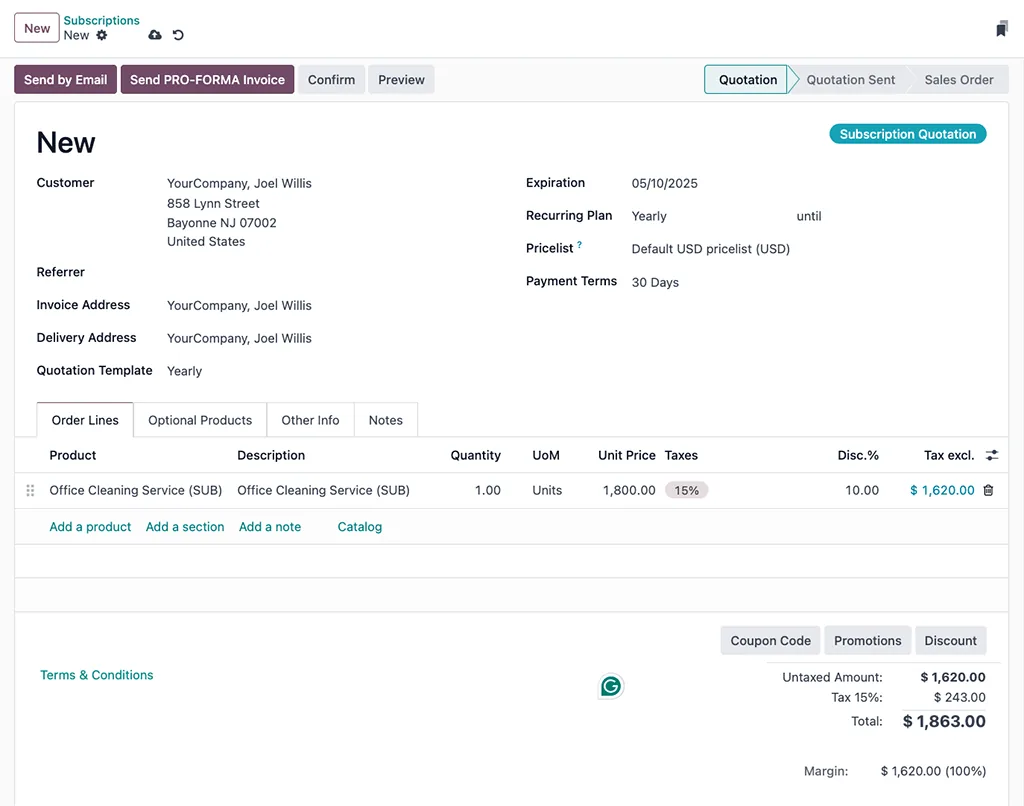
Once billing and the ledger share the same data, the recurring revenue view is built from posted transactions rather than a separate analytics tool.
We implement all four, so the right answer depends on your size, billing complexity and existing tools.
| Company profile | Often a good fit | Why |
|---|---|---|
| Early-stage SaaS, under 20 staff, self-serve plans | Zoho One (Zoho Billing, Books, CRM, Desk) | Subscription billing, CRM and accounting share one customer record at a modest per-user cost. |
| Growing SaaS with services and custom development | Odoo (Subscriptions, Accounting, Project, Helpdesk) | Recurring plans, timesheets and support live in one database, with deferred revenue handled in accounting. |
| Technical team that wants full control of the code | ERPNext | Open source on the Frappe framework, so in-house developers can extend billing and reporting themselves. |
| Multi-entity group with investors and audit pressure | Dynamics 365 Business Central | Strong consolidation, dimensions and audit trail, with Microsoft 365 and Power BI already familiar to finance. |
| Unusual usage-based pricing at high volume | Custom ERP or integration layer | Metering logic may sit in your product, with the ERP receiving rated usage for invoicing. |
Payment gateways such as Stripe, Checkout.com or Telr are usually connected rather than replaced.
We configure the ERP to support these rules. Confirm the treatment of your specific contracts with your tax advisor.
The standard rate is 5%. Supplies to non-resident customers may qualify for zero-rating under specific conditions, so the ERP needs customer residency and place-of-supply fields to apply the right tax code consistently.
Corporate tax is 9% above AED 375,000 of taxable income. A Qualifying Free Zone Person may get 0% on qualifying income subject to conditions, so revenue should be tagged by customer type and activity to support that analysis.
Under Ministerial Decisions 243 and 244 of 2025, B2B invoices move to the PINT AE format through Accredited Service Providers, mandatory from January or July 2027 depending on revenue. Check the latest Ministry of Finance and FTA guidance.
UAE-based employees are paid through the MOHRE Wage Protection System using a Salary Information File, which the payroll module can generate.
General information, not tax or legal advice. Rules change; confirm current FTA, MOHRE and Ministry of Finance guidance with your advisor.
Results depend on your starting point, but these are the improvements software teams usually aim for.
MRR, deferred revenue and recognized revenue come from the same ledger, so monthly reports stop needing reconciliation notes.
Recognition schedules and gateway reconciliation run automatically, leaving finance to review exceptions.
Engineering hours, hosting and contractor costs roll up by product, which helps with pricing and investment decisions.
Account managers see upcoming renewals alongside support history and usage, so conversations start earlier.
Durations are typical ranges for a focused rollout and vary with data volume and integrations.
Durations are typical ranges; your plan is agreed after discovery.
Review pricing models, contract types, gateway setup and current reporting gaps.
Define chart of accounts, revenue recognition rules, dimensions for product and region, and tax codes.
Set up subscriptions, connect the payment gateway and product sign-up flow, and build MRR reports.
Load active subscriptions with remaining terms and opening deferred balances so recognition continues correctly.
Run one billing cycle in parallel, compare results, then switch over and support the first close.
Explore the platforms, modules and services that matter most to SaaS and software product teams.
We configure the system for the rules UAE businesses report against, and test it before go-live.
General information, not tax or legal advice. Confirm current requirements with the FTA, MOHRE or your advisor. See all UAE compliance guides.
On-site workshops in Dubai, Abu Dhabi and Sharjah, and remote or on-site delivery across the Northern Emirates and free zones.
Official sources and references
Facts on this page were checked against these sources in October 2026. Rules change, so confirm current requirements before acting.
Still have a question? Our consultants are happy to help.
Ask an ExpertUsually yes. The gateway handles card capture and retries, while the ERP owns invoices, revenue recognition and the ledger. We connect the two so payouts, fees and refunds reconcile automatically.
Seat-based pricing is standard in all four platforms we implement. Usage-based billing works when your product sends rated usage to the ERP at the end of each period; very high-volume metering is usually better calculated in the product itself.
We load each active subscription with its start date, end date and amount already recognized. The opening deferred balance then ties to your last audited or management balance sheet before new schedules start.
No. The ERP records and tags income so you and your tax advisor can assess qualifying income and substance conditions. The qualification decision itself is a tax matter, not a software setting.
Yes. We add analytic dimensions or cost centers for product lines and link timesheets, hosting bills and contractor invoices to them. This also helps if you later need to support capitalization of development costs with your auditors.
Related Solutions
Related Industries
Related ERP Platforms
Related Guides
Tell us how you bill today and we will show you how deferred revenue, MRR and R&D costs would look in your chosen ERP.
Dubai, United Arab Emirates