L
O
A
D
I
N
G


Zoho, Odoo, ERPNext, Dynamics 365 and custom ERP, delivered by one accountable team.

Bill monthly, quarterly or annual plans automatically, collect by card or direct debit, handle upgrades and cancellations, and see recurring revenue in your accounts.
Subscription management software automates recurring billing for UAE businesses such as SaaS firms in Dubai Internet City, managed IT providers, gyms, coworking spaces and cleaning companies. It handles plans, add-ons and coupons in AED, proration on upgrades, card or direct debit collection, dunning for failed payments, and MRR, churn and deferred revenue reporting. Zoho, Odoo, ERPNext and Business Central offer options.
Subscription management software UAE businesses adopt is about one thing: making recurring revenue run without a person preparing invoices every month. SaaS companies in Dubai Internet City, managed IT providers, gyms and fitness studios, pest control and cleaning firms with monthly plans, coworking spaces, education providers and equipment rental firms all bill on a cycle. When that cycle runs on spreadsheets, invoices go out late, failed card payments go unnoticed and nobody can say what monthly recurring revenue actually is.
A proper subscription setup holds the plan, price, billing frequency and payment method for each customer. It raises the invoice on the right day, tries the card, retries if it fails, tells the customer, and records the payment in the ledger. Upgrades and downgrades mid-cycle are prorated. Annual prepayments are recognised month by month rather than all at once.
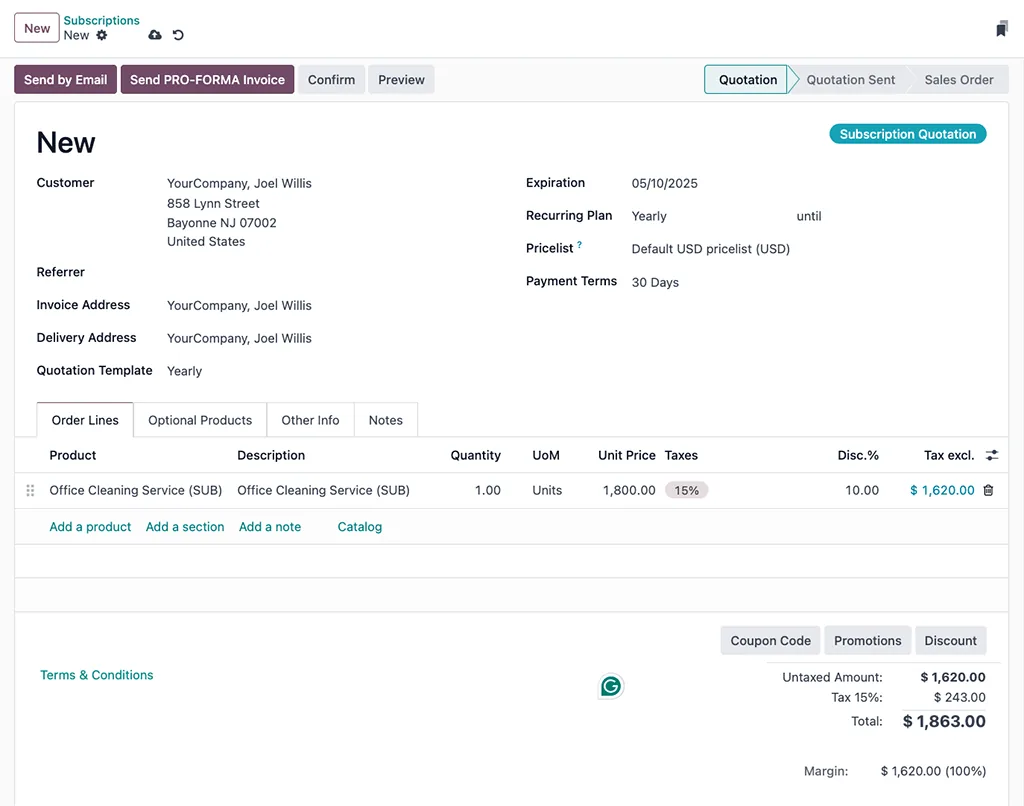
We implement subscription billing in Zoho Billing, Odoo Subscriptions, ERPNext and Dynamics 365 Business Central, connected to UAE payment gateways and to your general ledger. If your recurring billing is driven by negotiated agreements rather than standard plans, read our contract management software page as well.

The products we configure, integrate and support on projects like this one.


Product names and logos are trademarks of their respective owners and are shown only to identify the software we implement.
Owners and finance teams track the health of the subscription base rather than just this month's invoices.
Most subscription businesses follow the same cycle. The details that differ are proration rules, trial periods and how payment failures are handled.
One shared database: every step updates stock, finance and reports in real time.
These are the features that save the most time in a recurring business and reduce leakage.
Define base plans, optional add-ons and time-limited discounts once. Sales and the website use the same price list, so quotes and checkouts agree.
When a customer upgrades mid-cycle, the system calculates the difference and adds it to the next invoice or charges immediately, according to your policy.
Tokenised card details stored with the payment gateway, not in the ERP. Charges run automatically on the invoice date.
Automatic retries and reminder emails or WhatsApp messages when a payment fails, with rules for pausing service after a set number of attempts.
Customers update cards, download tax invoices and change plans without emailing your accounts team.
Annual or multi-month prepayments recorded as deferred revenue and released to income each month, which matches how most accountants want it reported.
Each platform can run recurring billing. The difference is how much subscription logic comes ready-made versus configured.
| Zoho | Odoo | ERPNext | Dynamics 365 Business Central | |
|---|---|---|---|---|
| Subscription tool | Zoho Billing (formerly Zoho Subscriptions) | Subscriptions app (Enterprise) linked to Sales and Accounting | Subscription and subscription plan records | Subscription Billing capabilities or partner apps |
| Plans and add-ons | Plans, add-ons and coupons | Recurring products, plans and optional products | Plans with item, price and billing interval | Service commitments on items |
| Proration | Native | Supported on upsells | Configurable | Depends on setup and app |
| Card collection and dunning | Native with supported gateways | Payment providers with automatic charge on invoice | Payment gateway integrations; dunning often configured | Through payment service integrations |
| MRR and churn reports | Native subscription analytics | MRR, churn and retention reports | Built with reports or dashboards | Built with reports or Power BI |
| Best fit | SaaS and service firms wanting a ready billing engine | Firms selling physical and recurring products together | Firms wanting open-source control of billing logic | Mid-size firms running finance on Microsoft |
Gateway support and feature depth differ by edition and region. We confirm UAE gateway compatibility before design.
Subscriptions depend on reliable payment and customer data. These are the connections UAE clients ask for most.
Recurring billing raises specific VAT and accounting questions. These are configuration notes, not tax advice; confirm treatment with your tax advisor.
Each recurring invoice to a VAT-registered customer needs the prescribed tax invoice fields, including your TRN. Templates are set once and applied to every cycle.
VAT on continuous or periodic supplies is generally due on the earliest of invoice date, payment date or the due date. Advance annual payments can create VAT liability before the service is delivered.
Taxable income starts from accounting profit, so how you recognise subscription revenue affects the figure. Consistent deferred revenue schedules give your advisor a clean basis.
Recurring B2B invoices will fall under the PINT AE e-invoicing model through an Accredited Service Provider once it applies to your business, from 2027 depending on revenue. Check the latest Ministry of Finance and FTA guidance.
General information, not tax or legal advice. Rules change; confirm current FTA, MOHRE and Ministry of Finance guidance with your advisor.
Explore subscription platforms and the industries that run on recurring revenue.
We configure the system for the rules UAE businesses report against, and test it before go-live.
General information, not tax or legal advice. Confirm current requirements with the FTA, MOHRE or your advisor. See all UAE compliance guides.
On-site workshops in Dubai, Abu Dhabi and Sharjah, and remote or on-site delivery across the Northern Emirates and free zones.
Official sources and references
Facts on this page were checked against these sources in October 2026. Rules change, so confirm current requirements before acting.
Still have a question? Our consultants are happy to help.
Ask an ExpertYes, through a payment gateway that supports tokenised recurring charges. We confirm the gateway works with your chosen platform and that your merchant account allows recurring transactions before going live.
Recurring invoices are still created automatically and sent by email or portal. Payments are then matched through bank reconciliation, and reminders follow if the invoice becomes overdue.
Yes. Trials, introductory pricing and coupons are standard in subscription tools. We set rules for what happens when a trial ends, such as converting to paid or pausing the account.
MRR normalises all active plans to a monthly amount, so an annual plan counts as one twelfth per month. We agree the definition with you, including how discounts and one-off fees are treated, so the figure matches finance.
Yes. We migrate customers, active plans, next billing dates and outstanding balances. Card tokens usually stay with the gateway, so moving gateways may require customers to re-enter cards.
If subscriptions are your main revenue, a dedicated engine like Zoho Billing or Odoo Subscriptions is usually worth it. If they are a small part of the business, recurring invoices in the core ERP may be enough.
Tell us how your business runs today and where it gets stuck. We'll recommend the right platform, outline the implementation approach and give you a realistic timeline, with no obligation.
Dubai, United Arab Emirates