L
O
A
D
I
N
G


Zoho, Odoo, ERPNext, Dynamics 365 and custom ERP, delivered by one accountable team.

Replace the depreciation spreadsheet with an asset register inside your ERP, where every laptop, vehicle, generator and fit-out has a tag, a custodian, a location and a book value.
Asset management software in the UAE is usually best run as the fixed asset register inside the ERP. Each asset is created from the vendor bill or capital work in progress, given a tag, QR code, custodian and location, and depreciated on the policy method. Transfers, revaluations and disposals post to the ledger, and physical counts use mobile scanning against the register.
Asset management software in the UAE solves a problem most finance teams know well: the fixed asset register lives in a spreadsheet that nobody fully trusts. Additions are keyed in weeks after the purchase invoice, transfers between branches are never recorded, and at year-end the auditor asks for a physical verification that takes a week of walking around warehouses in Al Quoz or site offices in Mussafah.
When the register sits inside the ERP, an asset is created from the vendor bill or the capitalized project cost, gets a tag number and a custodian, and starts depreciating on the method and useful life your policy sets. Moves between a Dubai head office and a Sharjah branch become transfer records, not emails. Disposals post the gain or loss automatically, and the net book value in the register always agrees with the general ledger.
We set up asset management on Zoho, Odoo, ERPNext, Microsoft Dynamics 365 or a custom build, depending on the ERP you run. If your main concern is keeping machines running rather than keeping the books right, start with our maintenance management software page; the two modules work best together.

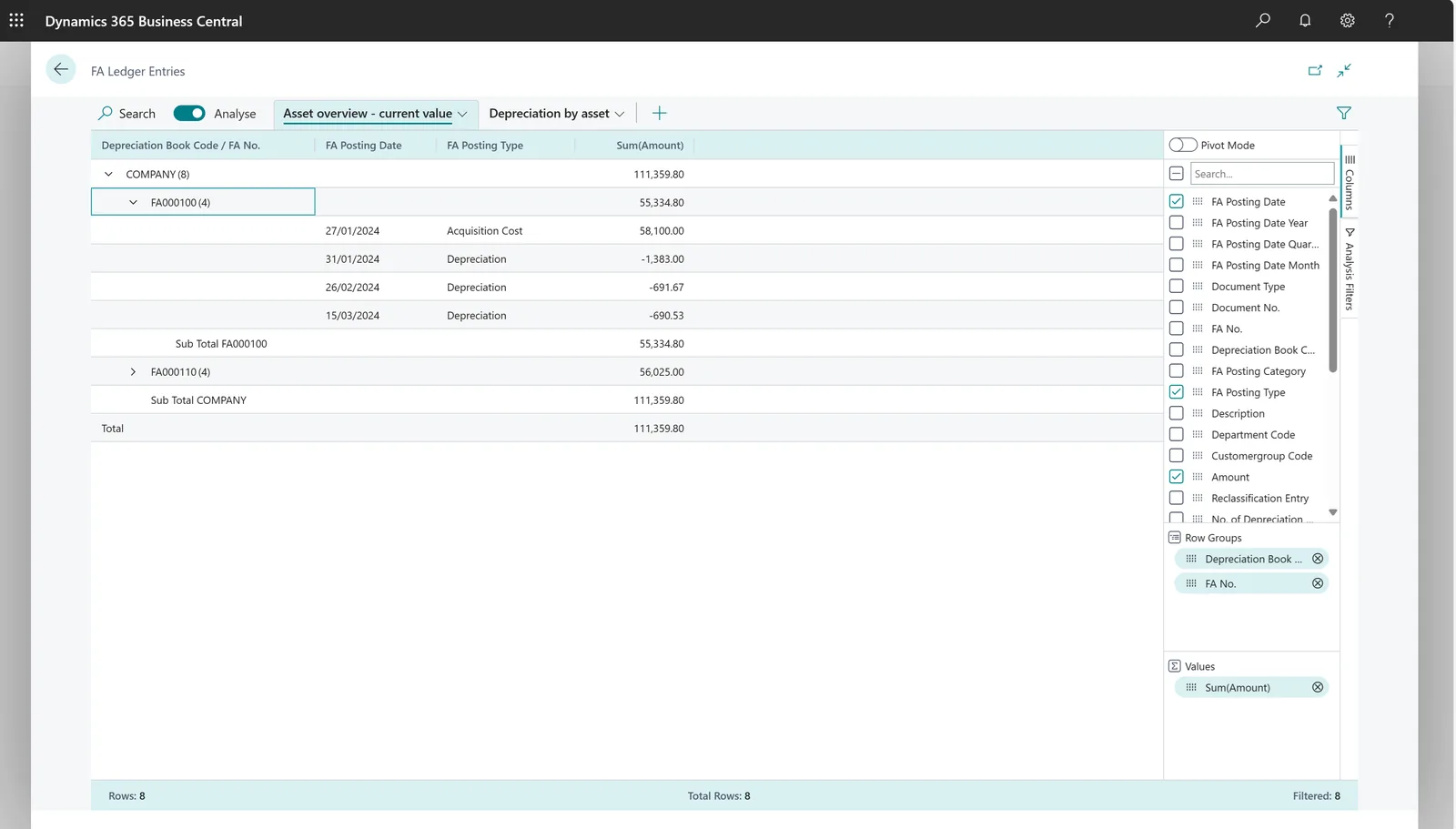
Finance, operations and the auditors look at the same register. Filters by company, branch, category and custodian replace the tabs of a spreadsheet.
Each stage creates a record and, where money moves, a journal entry. That is what turns the register into an audit trail rather than a list.
One shared database: every step updates stock, finance and reports in real time.
These are the capabilities we configure on most projects. The exact screens differ by platform, but the controls are the same.
Print barcode or QR labels from the register and verify assets with a phone or handheld scanner. Missing or unexpected items show up as exceptions instead of guesswork.
Straight line, declining balance or units of production, with useful lives set by category. Separate books can be kept where group reporting and local reporting need different lives.
Laptops, phones, cars and tools are assigned to named employees. Final settlement checklists can require asset return before end-of-service is paid.
Move assets between branches, warehouses, project sites or group companies with a dated transfer. Cost centers and intercompany entries follow the asset.
Fit-out, construction and machine installation costs collect in a CWIP account and are capitalized into one or more assets when the work is complete.
Attach invoices, warranty cards, insurance policies, Mulkiya copies and AMC contracts to the asset, with expiry reminders sent before they lapse.
All four can run a proper fixed asset register. The differences are in depth, edition and how much configuration is needed.
| Zoho | Odoo | ERPNext | Dynamics 365 | |
|---|---|---|---|---|
| Asset register | Fixed asset tracking is available in Zoho Books on certain plans; check your edition | Assets menu in Odoo Accounting with models per category | Built-in Asset doctype with categories and locations | Fixed Assets module in Business Central; deeper options in Finance |
| Depreciation | Common methods with scheduled journal entries | Linear and degressive methods, prorata and auto-posting | Straight line, written down value and manual schedules | Multiple depreciation books per asset |
| Transfers and custodians | Often extended with Zoho Creator for custodian flows | Analytic accounts and custom fields; Maintenance app for equipment | Asset Movement records location and custodian changes | FA locations and responsible employee fields |
| Maintenance link | Zoho FSM or Creator for service history | Native link to the Maintenance app | Asset Maintenance and Asset Repair records | Maintenance registration in BC; Field Service for complex needs |
| Best fit | Smaller registers inside a Zoho Books setup | Companies already on Odoo Accounting | Cost-conscious firms wanting full control | Groups with several entities and audit demands |
Features depend on version and edition. We confirm the fit against your asset policy during discovery.
An asset register is only current if the systems around it feed it.
The ERP supports the rules; your auditor and tax advisor confirm how they apply to you.
Under Federal Decree-Law No. 47 of 2022, taxable income generally starts from accounting profit, so depreciation calculated in the ERP feeds your corporate tax computation. Keep policy, useful lives and adjustments documented and confirm treatment with your tax advisor.
Input VAT on assets is recorded from the tax invoice like any other purchase, with the supplier TRN captured. The ERP keeps the link between the asset and its source invoice for the VAT audit trail.
Most UAE companies report under IFRS, which expects componentization, impairment review and disclosure of movements. The register produces the additions, disposals and depreciation roll-forward auditors ask for.
Asset records, invoices and disposal documents should be kept for the statutory retention period. Storing them against the asset in the ERP makes them easy to produce on request.
General information, not tax or legal advice. Rules change; confirm current FTA, MOHRE and Ministry of Finance guidance with your advisor.
Pages that connect to fixed asset control.
We configure the system for the rules UAE businesses report against, and test it before go-live.
General information, not tax or legal advice. Confirm current requirements with the FTA, MOHRE or your advisor. See all UAE compliance guides.
On-site workshops in Dubai, Abu Dhabi and Sharjah, and remote or on-site delivery across the Northern Emirates and free zones.
Official sources and references
Facts on this page were checked against these sources in October 2026. Rules change, so confirm current requirements before acting.
Still have a question? Our consultants are happy to help.
Ask an ExpertFor most UAE businesses the ERP module is enough, because the register, depreciation and journals stay in one place. Standalone tools make sense mainly for very large, technical asset bases such as utilities, where engineering data matters more than accounting.
Yes. We map cost, acquisition date, accumulated depreciation, category and location from your sheet, then reconcile the imported net book value to the trial balance before go-live. Gaps such as missing acquisition dates are flagged for your finance team to resolve.
We print tags, then use a mobile scanning screen or an exported checklist to record what is found at each location. The ERP compares the scan against the register and lists missing, moved and unregistered items for review.
Yes. Items below your capitalization threshold can be tracked as custodian equipment without depreciation, so you still know who holds them while the books follow your policy.
If the ERP is already live, adding the asset module and migrating the register often takes 3-6 weeks. It takes longer when the opening register needs significant clean-up or several companies are involved.
Vehicles can sit in the asset register for depreciation and custodians. For fuel, trips, Salik, fines and service intervals, our fleet management software page covers the operational side.
Related Solutions
Related Industries
Related ERP Platforms
Related Guides
Send us your current register and we will show how it maps into your ERP and what needs cleaning first.
Dubai, United Arab Emirates