L
O
A
D
I
N
G


Zoho, Odoo, ERPNext, Dynamics 365 and custom ERP, delivered by one accountable team.

Plant, crane, generator, scaffolding and access equipment rental firms in the UAE use ERP to bill every hire day correctly and keep assets certified and earning.
Equipment rental companies in the UAE use ERP to track each machine by serial number, location, hire status and certification date, and to bill hire contracts using day, week and month rates, minimum hire periods, transport and operator hours. Off-hire returns trigger inspection, damage charges and next availability, which suits plant, crane, generator, scaffolding and access equipment hire firms.
ERP for equipment rental companies in the UAE has to cope with assets that leave the yard on a low-bed, sit on a construction site for weeks or months, sometimes come with an operator, and return needing inspection and repair. Billing depends on hire start and off-hire dates, minimum hire periods, operator hours and overtime, transport charges and any damage found on return. One missed off-hire notice or one unbilled overtime sheet can wipe out the margin on a job.
Our clients in this sector include plant hire yards in Jebel Ali, Dubai Investment Park, Mussafah and Sharjah, generator and power rental firms serving events and construction, scaffolding and formwork suppliers, and forklift and access platform providers. Many also sell consumables, provide maintenance contracts or resell used equipment, so the ERP must handle rentals alongside normal sales.
This page focuses on heavy and commercial equipment. For vehicle rental, see ERP for car rental companies. For tracking and maintaining the assets themselves, our asset management software page goes deeper.
These issues are common across plant hire, power rental and scaffolding businesses.
Customers claim they called off-hire days before collection. Without a recorded off-hire request and reference, billing disputes reduce what you can collect.
Operator hours are written on paper sheets signed on site. Sheets arrive late or not at all, so overtime goes unbilled and payroll does not match invoices.
Cranes, lifting gear and access platforms need valid third-party inspection certificates. An expired certificate on site is a safety and contract risk.
Bulk items like tubes, fittings and boards go out by quantity. Shortages on return are hard to prove without counted delivery and return notes.
Management cannot see which asset classes earn their capital cost. Buying decisions rely on instinct rather than time-on-hire data.
We configure each step so the contract, the asset and the invoice stay linked.
One shared database: every step updates stock, finance and reports in real time.
These modules cover serialized machines and bulk rental items alike.
Rates by day, week or month, minimum hire periods, standby rates and transport charges on one contract.
Calendar view of each asset class showing what is on hire, reserved, in the yard or under repair.
Signed delivery tickets and return notes with quantities for bulk items and meter readings for machines.
Mobile timesheets signed by the site supervisor, feeding both the customer invoice and operator payroll.
Each machine as a fixed asset with cost, depreciation, location and disposal records.
Preventive maintenance by engine hours or dates, plus third-party inspection certificate tracking.
Periodic or end-of-hire invoices calculated from on-hire and off-hire dates, with damage and shortage charges.
Fuel, spare parts and ex-rental equipment sold alongside rentals in the same ledger.
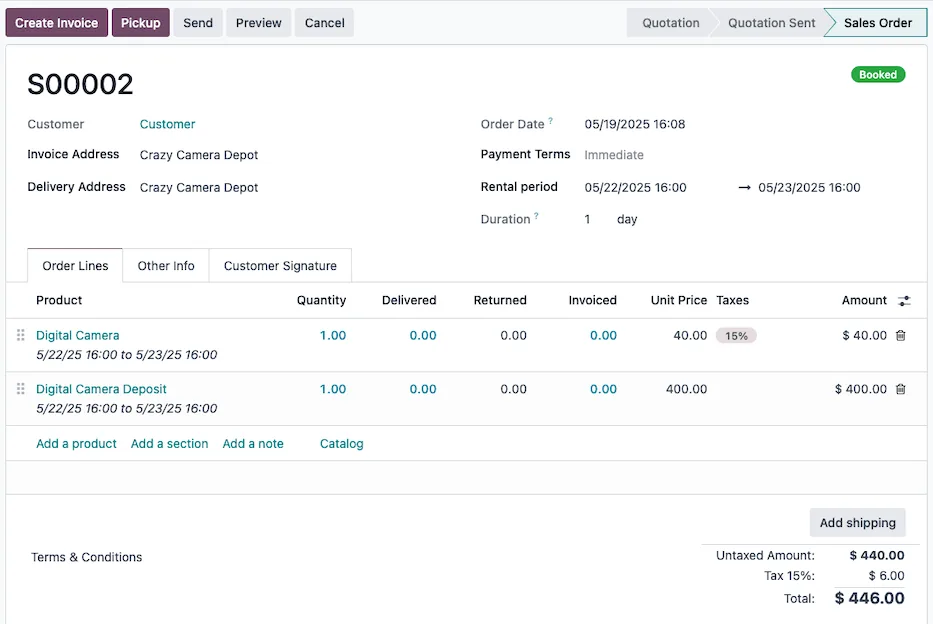
Hire desk, yard and finance teams work from the same asset status.
The right platform depends on fleet size, bulk versus serialized items, and integration needs.
| Rental company profile | Often a good fit | Why |
|---|---|---|
| Small tool or access equipment hire | Odoo (Rental, Inventory, Accounting) | Rental orders with pickup and return, serial tracking and invoicing in one system. |
| Plant hire with operators and wet hire | Odoo or ERPNext with timesheet customization | Timesheets, maintenance and asset modules connect operator hours to billing. |
| Scaffolding and formwork supplier | ERPNext or custom module | Quantity-based hire with partial returns and shortage charges needs flexible logic. |
| Multi-branch rental group | Dynamics 365 Business Central | Fixed assets, dimensions by branch and consolidation, with rental extensions or integration. |
| Firm already using Zoho for CRM and accounting | Zoho Creator app with Zoho Books | A custom rental app on Creator connected to existing Zoho data. |
We configure ERP to support these requirements. Confirm tax treatment with your tax advisor.
Equipment hire and related transport are generally standard-rated at 5%. Long hires invoiced periodically need correct tax point handling on each invoice.
Lifting equipment and access platforms usually need valid third-party inspection certificates. The ERP stores certificate numbers and expiry dates and can block hire of non-compliant assets.
Depreciation on high-value fleet affects taxable income at 9% above AED 375,000. Your advisor confirms any tax adjustments to accounting depreciation.
Hire invoices to contractors are B2B and will move to PINT AE e-invoices through an Accredited Service Provider from 2027. Check the latest Ministry of Finance and FTA guidance.
General information, not tax or legal advice. Rules change; confirm current FTA, MOHRE and Ministry of Finance guidance with your advisor.
Benefits we design for; results depend on how consistently teams record hires and returns.
On-hire and off-hire dates drive invoices automatically, so long hires are invoiced on schedule.
Time-on-hire reports show which asset classes to grow, reprice or sell.
Certificate and maintenance alerts reduce the chance of an uncertified machine reaching site.
Signed digital timesheets support both overtime billing and accurate payroll.
Typical ranges; fleets with thousands of bulk items need more data preparation.
Durations are typical ranges; your plan is agreed after discovery.
Review rate cards, hire terms, yard process and maintenance practice.
Define asset classes, rental rules, billing cycles and timesheet approvals.
Set up rental, assets, maintenance, mobile timesheets and delivery documents.
Import assets with book values, certificates, current hires and open off-hire requests.
Train hire desk, yard and operators, then review the first billing run together.
Asset, rental and construction-related resources.
We configure the system for the rules UAE businesses report against, and test it before go-live.
General information, not tax or legal advice. Confirm current requirements with the FTA, MOHRE or your advisor. See all UAE compliance guides.
On-site workshops in Dubai, Abu Dhabi and Sharjah, and remote or on-site delivery across the Northern Emirates and free zones.
Official sources and references
Facts on this page were checked against these sources in October 2026. Rules change, so confirm current requirements before acting.
Still have a question? Our consultants are happy to help.
Ask an ExpertYes. Dry hire contracts bill the equipment only, while wet hire adds operator charges from approved timesheets. Both can appear on the same contract or invoice.
The contract stores the minimum period and rate structure. If a machine is off-hired early, billing still applies the minimum charge automatically.
Yes. Bulk items are tracked by quantity per customer site, with partial returns recorded and any shortage billed at the agreed replacement rate.
The ERP can flag or block assets whose certificate has expired, and alert the yard well before the expiry date.
Most platforms we use offer a customer portal where clients view equipment on hire, invoices and delivery notes, and can request off-hire.
GPS and telematics data can be integrated where your tracking provider offers an API, showing location and engine hours against the asset record.
Tell us how your business runs today and where it gets stuck. We'll recommend the right platform, outline the implementation approach and give you a realistic timeline, with no obligation.
Dubai, United Arab Emirates