L
O
A
D
I
N
G


Zoho, Odoo, ERPNext, Dynamics 365 and custom ERP, delivered by one accountable team.

One system for buying collections, allocating stock across mall stores and online, managing markdowns and handling exchanges without losing track of a single size.
A fashion retailer in the UAE needs an ERP that treats each style as a size and colour matrix, tracks stock by store and online, tags collections by season and manages markdowns. One shirt in five sizes and four colours is twenty SKUs, so the system should show sell-through by style, size and store and suggest transfers between branches such as Dubai Mall and Yas Mall before Eid or DSF.
An ERP for fashion retail in the UAE has to treat one style as dozens of separate stock units. A single shirt in five sizes and four colors is twenty SKUs, and a store in Dubai Mall may sell out of medium navy while the Yas Mall branch sits on six of them. Fashion retailers lose margin not because they bought the wrong style, but because the right size was in the wrong store at the wrong time.
Seasons add pressure. Collections are bought months ahead, land in a short window before Eid, summer or the Dubai Shopping Festival, and must sell through at full price before markdowns start. Retailers need to see sell-through by style, size and store every week, and move stock between branches while it can still sell at full price.
Most boutique groups and franchise operators we meet run a POS that knows sizes but an accounting system that does not, plus spreadsheets for buying plans. We bring these together on Odoo, Zoho, ERPNext or Dynamics 365, with product variants, multi-store stock and retail POS sharing one item master. For general retail formats, see our retail ERP overview.
Common patterns across boutiques, footwear chains and franchise brands operating in UAE malls.
Stores keep selling the popular sizes and are left with extra-small and extra-large. Without a size-level view, nobody rebalances stock across branches until markdown time.
Buyers see sell-through only at season end. By then discounts need to be deeper, and the margin plan for the collection is already lost.
A customer buys in one mall and exchanges in another. If stores are not on the same system, the exchange creates a stock error in both places.
Freight, duty and clearing charges arrive weeks after the goods. Without proper landed cost allocation, gross margin per style is overstated.
The website shows sizes available that are actually sitting in a store fitting room. Canceled online orders damage the brand quickly.
Some mall leases and concession arrangements require periodic sales reporting. Pulling these figures from separate tills is slow and error-prone.
The fashion cycle runs on seasons. Each stage should update the same product records.
One shared database: every step updates stock, finance and reports in real time.
Every module below should understand product variants, not just single SKUs.
Styles with size and color attributes, matrix entry on purchase orders and size-level barcodes for tags.
Fast checkout, exchange and return against the original receipt from any branch, gift cards and loyalty points.
Size-ratio purchase orders to overseas suppliers and allocation of freight, duty and clearing to each style.
Stock per store, warehouse and online channel, with transfer requests generated from size gaps.
Season-based price lists, scheduled markdown waves and promotion rules applied consistently in every store.
Shared stock with Shopify, WooCommerce or the platform's own web store, so online availability reflects reality.
Customer profiles linked to purchases for clienteling, size preferences and targeted collection launches.
Store profit and loss, gross margin by collection, and VAT figures generated from the same transactions.
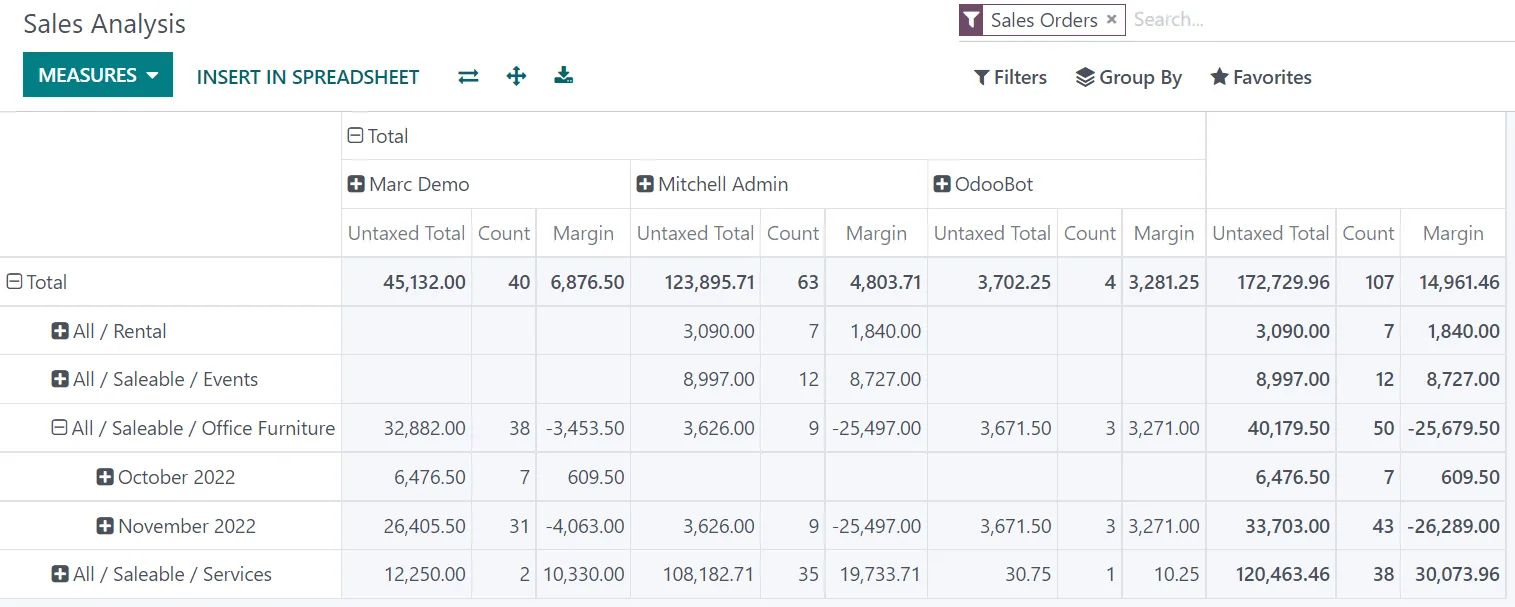
Fashion buyers and merchandisers live in this view during the season.
Variant handling is the deciding factor. All four platforms support it, but depth and effort differ.
| Fashion business profile | Often a good fit | Why | Watch-outs |
|---|---|---|---|
| Single boutique with online store | Zoho Inventory with Zoho Commerce or Shopify, or Odoo | Variants, POS and web stock in a manageable setup for a small team. | Check gift card and exchange flows match your policy. |
| Multi-mall chain, five to twenty stores | Odoo | Variant-aware POS, inventory, transfers and ecommerce on one database. | Plan barcode and tag printing for every size before go-live. |
| Franchise operator with several brands | Dynamics 365 Business Central or Odoo multi-company | Separate brands and legal entities with consolidated reporting. | Each brand's item coding must be agreed up front. |
| Brand that also manufactures or sources private label | Odoo or ERPNext | Purchasing, simple manufacturing and retail stock in one flow. | If production is complex, see garment manufacturing scope separately. |
| Retailer with a special allocation model | Custom ERP or extended Odoo | Bespoke allocation and replenishment logic for large ranges. | Custom logic needs documentation and long-term support. |
We configure the system to support these requirements. Confirm tax treatment with your tax advisor.
Standard-rated sales at the till need receipts showing your TRN and required details, with full tax invoices available for business customers.
Many UAE fashion retailers take part in the tourist VAT refund scheme. The POS needs to issue qualifying invoices and pass data to the scheme operator's system; requirements are set by the FTA and the operator, so confirm current rules before setup.
Exchanges and refunds must produce tax credit notes that reverse the right amount of VAT, including when the return happens in a different store or period.
Wholesale or corporate uniform sales fall within the UAE e-invoicing framework using PINT AE through an Accredited Service Provider. Mandatory dates depend on revenue, so check the latest Ministry of Finance and FTA guidance.
General information, not tax or legal advice. Rules change; confirm current FTA, MOHRE and Ministry of Finance guidance with your advisor.
Outcomes depend on how well buying and store teams adopt the data, but these are the targets we design for.
Size gaps are spotted mid-season and stock is moved to the store where it sells, rather than marked down where it does not.
Weekly sell-through data lets buyers plan smaller, earlier markdowns instead of deep end-of-season clearance.
Every branch sees the original sale, so exchanges post correctly and stock stays accurate in both locations.
Landed costs are allocated to each style, so gross margin reflects freight and duty, not just supplier price.
We time go-live away from peak trading periods such as Eid and DSF. Durations are typical ranges.
Durations are typical ranges; your plan is agreed after discovery.
We map your style coding, size scales, season structure and exchange policy with buying and store teams.
Existing styles are converted to variant structures, with barcodes, prices and season tags per size and color.
POS, transfers, landed cost, markdown rules and the ecommerce connector are set up and tested together.
One store goes live first, followed by the rest in small groups, each starting with a full count by size.
After the first season we review sell-through reports with buyers and refine allocation and markdown rules.
Explore retail systems, ecommerce and the platforms behind them.
We configure the system for the rules UAE businesses report against, and test it before go-live.
General information, not tax or legal advice. Confirm current requirements with the FTA, MOHRE or your advisor. See all UAE compliance guides.
On-site workshops in Dubai, Abu Dhabi and Sharjah, and remote or on-site delivery across the Northern Emirates and free zones.
Official sources and references
Facts on this page were checked against these sources in October 2026. Rules change, so confirm current requirements before acting.
Still have a question? Our consultants are happy to help.
Ask an ExpertYes. Most platforms we implement support matrix entry, where you enter quantities per size and color in a grid. Some teams also use size ratio templates so a buyer enters a total and the system spreads it across sizes.
The cashier looks up the original receipt, which is visible from any store on the same system. The returned item goes into that store's stock, and the replacement is sold from it, with VAT adjusted correctly.
Yes. We connect Shopify or WooCommerce so products, stock and orders sync with the ERP. Odoo and Zoho also offer their own web store options if you prefer one system.
We configure POS invoices and data exchange to support participation, based on the current requirements of the FTA and the scheme operator. Confirm eligibility and procedures with your tax advisor and the operator.
Avoid peak periods such as Eid, the Dubai Shopping Festival and back-to-school. Most fashion retailers go live between seasons, after a clearance sale has reduced stock to count.
Related Solutions
Related Industries
Related ERP Platforms
Talk to our retail team about an ERP that understands styles, sizes and seasons as well as your buyers do.
Dubai, United Arab Emirates