L
O
A
D
I
N
G


Zoho, Odoo, ERPNext, Dynamics 365 and custom ERP, delivered by one accountable team.

Whether you run ten pickups or five hundred trucks, every vehicle carries renewals, servicing, fuel, tolls and fines. We set up ERP so nothing expires unnoticed and every cost lands on the right vehicle and driver.
An ERP for fleet management in the UAE keeps a register of every vehicle with documents and expiry dates, plans servicing by kilometres or time, allocates fuel, Salik and Darb toll costs per vehicle, and assigns traffic fines to the responsible driver. Odoo has a Fleet app and ERPNext has vehicle logs, while Zoho and Dynamics 365 can be configured similarly.
An ERP for fleet management UAE companies use is not only for transport businesses. Contractors, facility management firms, distributors, rental companies and service businesses all run fleets of pickups, vans, buses, trucks and plant. The vehicles are often the second-largest cost after salaries, yet their records are spread across RTA renewal reminders, insurance emails, garage invoices, fuel card statements and traffic fine notices.
Bringing fleet management into the ERP means the vehicle record connects to the people and accounts that matter: the driver assigned today, the project or department that uses the vehicle, the asset register that depreciates it and the supplier who services it. A fine in Abu Dhabi can be traced to the driver who had the vehicle that afternoon, and a service invoice can be checked against the agreed schedule.
This page covers the vehicle lifecycle from acquisition to disposal. If your business sells transport services and you need trip-level revenue and costing, see our page on ERP for transport companies, which builds on the same fleet records.
These issues appear in most UAE companies with more than a handful of vehicles.
When a vehicle's registration or insurance lapses, it cannot legally be driven and fines can follow. Renewal dates tracked in a spreadsheet are easy to miss.
Traffic fines accumulate against the vehicle owner and often surface at renewal. By then it is hard to prove which driver was responsible.
Without a service schedule by kilometers, some vehicles miss oil changes while others are serviced early. Both raise costs and shorten vehicle life.
Fuel card statements arrive as long lists. Without matching to vehicles and odometer readings, unusual consumption goes unnoticed.
Contractors and FM companies need vehicle costs on project or contract accounts. When costs sit in one fleet expense account, project margins are overstated.
Without total cost of ownership per vehicle, it is hard to know when an old truck is costing more than a new one would.
Each stage creates records that link the vehicle to finance, HR and operations.
One shared database: every step updates stock, finance and reports in real time.
Most of these exist as standard or near-standard features on the platforms we implement; some need configuration.
Plate, chassis, make, model, registration and insurance details, permits and scanned documents per vehicle.
Reminders for registration, insurance, permits and lease end dates sent to the fleet coordinator ahead of expiry.
Who had which vehicle and when, linked to employee records and driving license expiry.
Fuel card, Salik and Darb transactions imported and allocated to vehicles, with consumption per kilometer.
Service plans by kilometers or months, work orders for workshops, tyre and battery records and repair history.
Fines recorded against vehicle and date, matched to the assigned driver and recovered through payroll where policy allows.
Vehicles capitalized in the fixed asset register with depreciation, revaluation and disposal gain or loss.
Fuel, service, depreciation and insurance charged to departments, projects or contracts that use each vehicle.
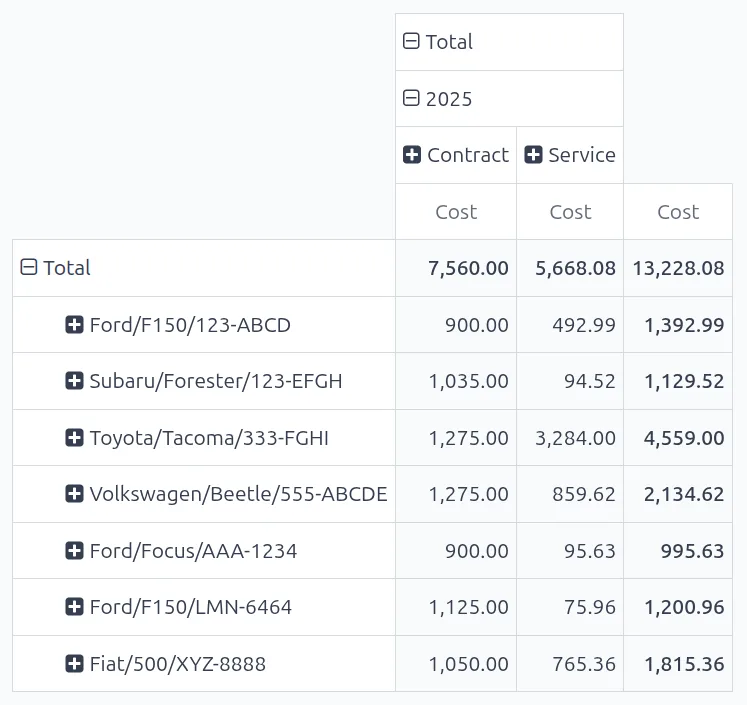
A fleet dashboard is driven by dates and costs. This is what we usually set up.
All four platforms we implement can manage fleets. The fit depends on fleet size and how tightly vehicles must tie to projects and payroll.
| Fleet profile | Usual fit | Why |
|---|---|---|
| Service company with a small fleet of vans | Zoho Creator with Zoho Books | A simple vehicle app with renewals and costs, posting expenses to Books. |
| Contractor or FM company with vehicles on projects | Odoo | Fleet app tracks vehicles, contracts, services and odometer; costs can link to projects and analytic accounts. |
| Company wanting fleet tied to HR and assets | ERPNext | Vehicle and vehicle log records sit alongside employees, asset depreciation and maintenance schedules. |
| Large multi-entity group with heavy vehicles | Dynamics 365 | Fixed assets and maintenance across companies, with telematics and fuel card integrations. |
| Fleet with telematics-driven workflows | Custom ERP or integration | GPS and engine data trigger service work orders and driver scoring. |
The ERP helps you keep the records these requirements depend on. Confirm specific obligations with your advisors and the licensing authority.
Vehicles must hold valid registration and insurance to be driven. Expiry alerts and document storage help ensure renewals happen on time with the issuing authority.
Input VAT recovery on vehicles and running costs depends on how vehicles are used, and some motor vehicles available for private use have restrictions. Tax codes per vehicle category support the treatment your tax advisor confirms.
Deducting fines from salaries must follow UAE Labour Law and your employment contracts. The ERP records each deduction against the fine for transparency.
Vehicle depreciation in the fixed asset register feeds the financial statements used for corporate tax. Confirm the tax treatment with your advisor.
General information, not tax or legal advice. Rules change; confirm current FTA, MOHRE and Ministry of Finance guidance with your advisor.
These outcomes depend on how consistently the data is used. We help you measure them from your own baseline.
Alerts ahead of expiry give time to arrange inspections and insurance.
The assignment log identifies who had the vehicle at the time of each fine.
Service schedules reduce breakdowns and unplanned workshop visits.
Fuel, service, tolls, insurance and depreciation together support keep-or-replace decisions.
Fleet modules are often a phase within a wider ERP project. These ranges apply when it is a standalone phase.
Durations are typical ranges; your plan is agreed after discovery.
Gather registration cards, insurance policies, lease contracts and service history for every vehicle.
Set up vehicle categories, service plans, renewal alerts, cost allocation and asset accounting.
Connect fuel card and toll statements and, where available, telematics data.
Train fleet coordinators, workshop staff and accounts, and agree the fine recovery process with HR.
Software, platform and industry pages connected to fleet management.
We configure the system for the rules UAE businesses report against, and test it before go-live.
General information, not tax or legal advice. Confirm current requirements with the FTA, MOHRE or your advisor. See all UAE compliance guides.
On-site workshops in Dubai, Abu Dhabi and Sharjah, and remote or on-site delivery across the Northern Emirates and free zones.
Official sources and references
Facts on this page were checked against these sources in October 2026. Rules change, so confirm current requirements before acting.
Still have a question? Our consultants are happy to help.
Ask an ExpertOften not. Odoo has a Fleet app, ERPNext has vehicle and vehicle log records, and Zoho and Dynamics 365 can be configured for vehicles. A separate telematics platform may still be useful for live tracking, integrated with the ERP.
Fines can be imported from exported lists and matched to the driver assignment log by vehicle and date. A fleet coordinator reviews the match before recovery, since assignments are not always perfect.
Fuel card transactions carry a card or plate reference, which the ERP maps to a vehicle. Combined with odometer readings, this gives consumption per kilometer and flags unusual fills.
Yes. Vehicle costs can be allocated by assignment, days used or kilometers to projects, contracts or departments, which matters for contractors and facility management companies.
Yes. Lease contracts are recorded with payment schedules, end dates and return conditions. Accounting treatment for leases should follow your auditor's guidance.
Related Solutions
Related Industries
Related ERP Platforms
Related Guides
Send us your vehicle list and a recent fuel statement, and we will show how your fleet would look inside an ERP.
Dubai, United Arab Emirates