L
O
A
D
I
N
G


Zoho, Odoo, ERPNext, Dynamics 365 and custom ERP, delivered by one accountable team.

We set up Odoo Maintenance so your technicians know what to service this week, breakdowns are logged in seconds, and every machine has a full repair history.
Odoo Maintenance gives each machine a record with category, location, vendor, warranty date and maintenance team, schedules preventive work at fixed frequencies and lets operators raise breakdown requests from a desk or phone. Requests move across a Kanban board, and Odoo calculates mean time between failures and mean time to repair. UAE factories often link it to Odoo Manufacturing.
Odoo Maintenance UAE projects are common in plants where maintenance still runs on a whiteboard, a WhatsApp group and the memory of one senior technician. A compressor fails in July heat, the line stops, and nobody can say when it was last serviced or which spare part was fitted. Preventive tasks slip because production always seems more urgent, and the cost of downtime never shows up clearly in the accounts.
Odoo Maintenance gives every piece of equipment a record with its category, location, vendor, warranty date and assigned maintenance team. Preventive maintenance can be scheduled at a fixed frequency, and corrective requests can be raised by operators from a desk or a phone. Requests move across a Kanban board from new to in progress to repaired, and Odoo calculates indicators such as mean time between failures and mean time to repair per machine.
We configure Odoo Maintenance for manufacturers, food processors, workshops and building operators. Factories usually link it to Odoo Manufacturing so work center downtime is visible to planners. For a platform-neutral comparison, see maintenance management software UAE.
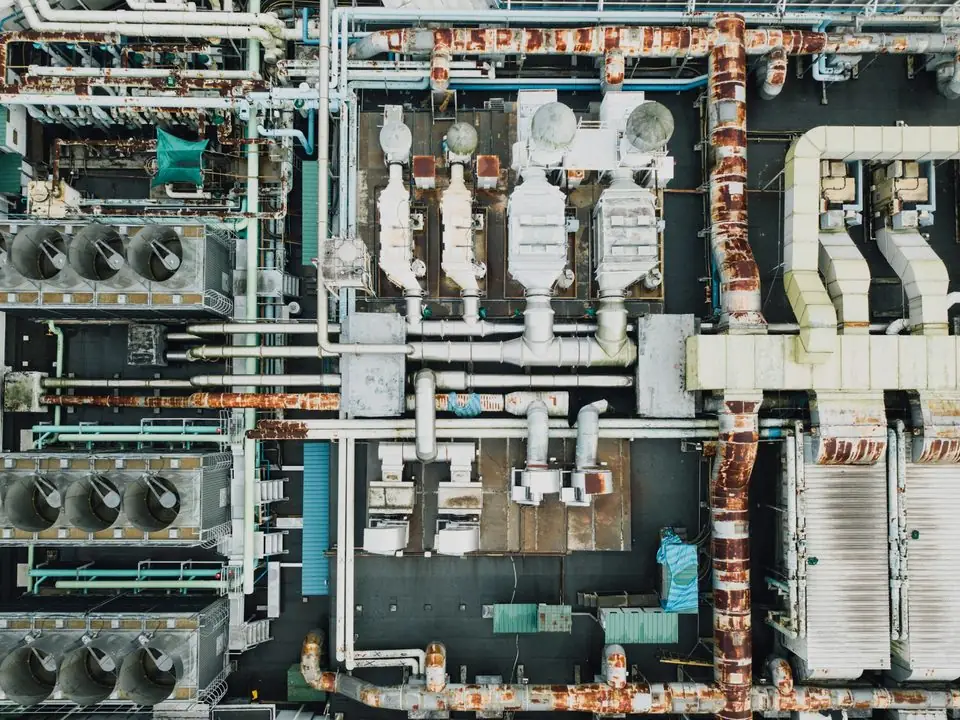
The products we configure, integrate and support on projects like this one.
 Odoo Maintenance
 Odoo Invoicing / Accounting
 Odoo Sales
 Odoo CRM
 Odoo Inventory
 Odoo Purchase
Product names and logos are trademarks of their respective owners and are shown only to identify the software we implement.
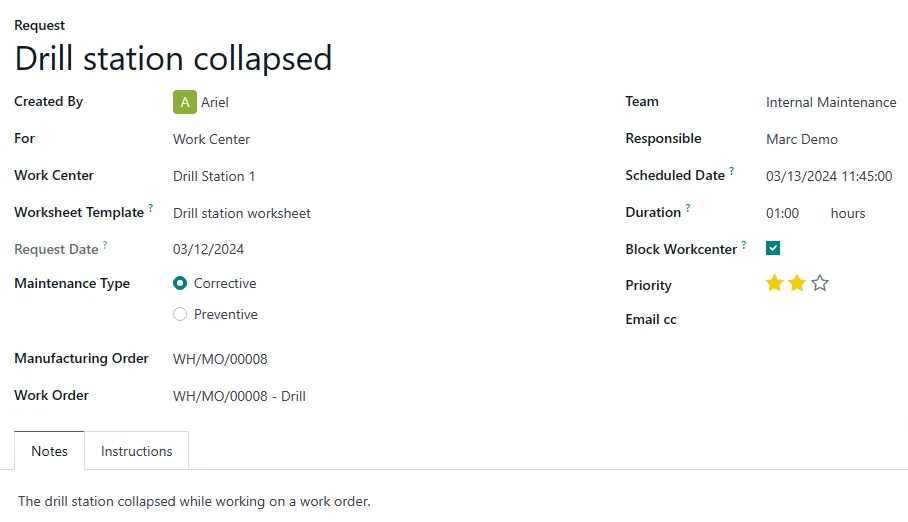
Maintenance managers see open requests, upcoming preventive work and which machines are causing the most downtime.
The corrective cycle we set up for most sites. Preventive requests follow the same path, created automatically by schedule.
One shared database: every step updates stock, finance and reports in real time.
The app is simple by design. Most of our work is structuring equipment and connecting it to stock, production and costs.
Equipment grouped by category and location, with serial number, vendor, cost, warranty end date and responsible technician.
Separate teams for mechanical, electrical, HVAC or facilities work, each with its own request board.
Recurring requests created at a set frequency so lubrication, filter changes and calibrations are never forgotten.
Breakdown requests with priority, photos and description, raised by operators from a browser or the Odoo mobile app.
A calendar of planned work so shutdowns can be agreed with production in advance.
Spares managed as stock items in Odoo Inventory, with consumption against repairs set up through transfers or a light customization.
In factories, equipment links to manufacturing work centers so planners see when a machine is blocked for maintenance.
Step-by-step checklists for inspections and services, so each technician follows the same procedure.
Maintenance draws on several other Odoo apps and, in some plants, on machine data. Sensor or SCADA integrations are possible through custom development and are scoped case by case.
Maintenance records are often requested during audits and inspections. Odoo keeps them complete and dated; the regulatory obligations themselves depend on your sector.
Records of inspections for lifting equipment, pressure vessels, fire systems and similar assets help when authorities or insurers ask for proof of servicing. Requirements vary by emirate and sector.
Food plants working toward HACCP or ISO 22000 audits need calibration and hygiene maintenance records. Checklists in Odoo create a dated trail for each task.
Equipment can link to fixed assets in Odoo Accounting so depreciation and capitalized major repairs are recorded correctly for corporate tax purposes.
External maintenance contractors' invoices flow through Odoo Purchase with the correct 5% input VAT, recoverable subject to your advisor's guidance.
General information, not tax or legal advice. Rules change; confirm current FTA, MOHRE and Ministry of Finance guidance with your advisor.
Good maintenance data takes discipline. These steps make it stick.
More on maintenance, assets and manufacturing systems in the UAE.
We configure the system for the rules UAE businesses report against, and test it before go-live.
General information, not tax or legal advice. Confirm current requirements with the FTA, MOHRE or your advisor. See all UAE compliance guides.
On-site workshops in Dubai, Abu Dhabi and Sharjah, and remote or on-site delivery across the Northern Emirates and free zones.
Official sources and references
Facts on this page were checked against these sources in October 2026. Rules change, so confirm current requirements before acting.
Still have a question? Our consultants are happy to help.
Ask an ExpertIt covers the core of a CMMS: equipment, preventive and corrective requests, teams, calendar and reliability indicators. Sites needing condition-based triggers from sensors, detailed labor costing or complex permit-to-work processes usually need customization or a dedicated system linked to Odoo.
Standard preventive scheduling in Odoo is frequency based. Usage-based triggers, such as running hours or production counts, can be added through customization or by linking to manufacturing data, which we scope based on your equipment.
Yes. Technicians can open requests, update stages, add notes and attach photos from the Odoo mobile app or a mobile browser, which suits large plants and multi-building sites.
Spares live in Odoo Inventory with reorder rules so critical parts are not missed. Linking parts consumption directly to each maintenance request is usually done with a small customization or a defined internal transfer process.
For in-house facilities teams, yes. Facility management companies serving external clients usually also need contracts, SLAs and client billing, which is better handled with Field Service and Helpdesk alongside Maintenance.
With an equipment list ready, a single site can often go live in 3 to 6 weeks. Multi-site rollouts with spare parts, manufacturing links and imported history usually take longer.
Tell us how your business runs today and where it gets stuck. We'll recommend the right platform, outline the implementation approach and give you a realistic timeline, with no obligation.
Dubai, United Arab Emirates