L
O
A
D
I
N
G


Zoho, Odoo, ERPNext, Dynamics 365 and custom ERP, delivered by one accountable team.

ERPNext accounting is part of the same system as your sales, purchasing and stock. We configure it for UAE VAT, corporate tax tracking and the way your finance team closes the month.
ERPNext accounting gives UAE finance teams full double-entry books inside the same open-source system as sales, purchasing and stock, without per-module licence fees. It covers the chart of accounts, cost centres, accounting dimensions, bank reconciliation, budgets, multi-currency and period closing. A UAE regional setup adds tax fields and a VAT 201 report, though tax templates still need configuring and testing.
ERPNext accounting in the UAE appeals to finance teams who want full double-entry books without per-module licence fees. Every sales invoice, purchase invoice, delivery and receipt posts to the general ledger automatically, so the accounts reflect what operations actually did rather than what someone keyed in later.
The accounting module covers the chart of accounts, journal entries, payment entries, receivables and payables, bank reconciliation, budgets, cost centers and accounting dimensions, multi-currency, and period closing. ERPNext also ships a UAE regional setup that adds tax fields and a UAE VAT 201 report, which gives finance a starting point for preparing the return they file on EmaraTax.
Getting value from it depends on setup. We design the chart of accounts for your reporting needs, build Item Tax Templates and tax categories for standard-rated, zero-rated, exempt and reverse-charge supplies, and test the VAT 201 output against the ledger before you rely on it. Companies comparing finance tools can also read our guide to the best accounting ERP for the UAE.

The products we configure, integrate and support on projects like this one.
 ERPNext
 Frappe HR
 Frappe Framework
 Frappe CRM
Product names and logos are trademarks of their respective owners and are shown only to identify the software we implement.
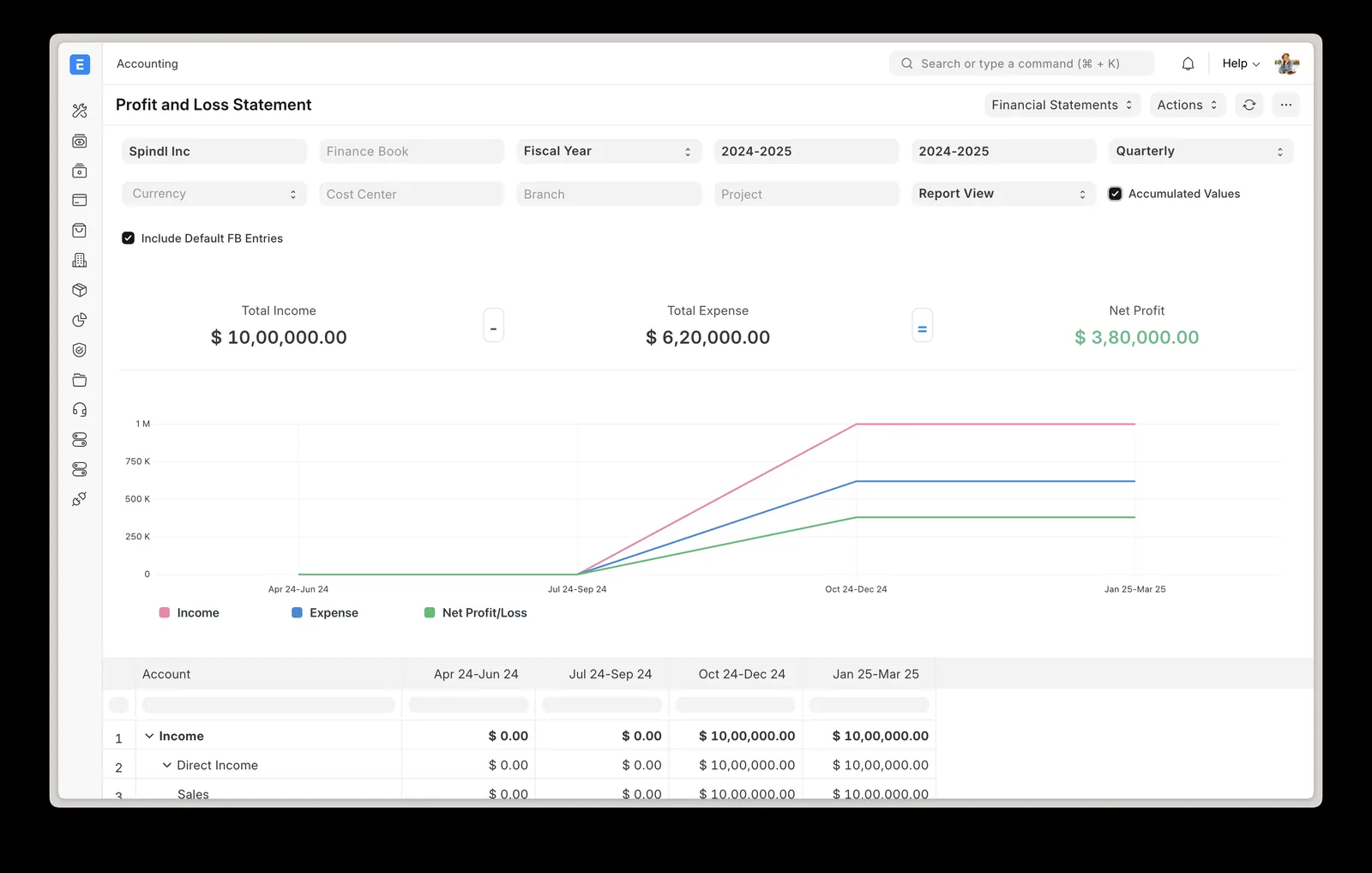
Finance managers get a live picture of cash, receivables and tax without waiting for exports.
A typical close for a UAE trading or services company follows these steps, most of them supported by built-in tools.
One shared database: every step updates stock, finance and reports in real time.
These are the parts of the accounting module UAE clients use most. All are standard ERPNext features configured for your business.
A tree of accounts plus cost centers and custom accounting dimensions, such as branch or business line, for segment reporting.
Tax invoices with TRN, VAT breakdown and Arabic-English print formats, linked to orders and deliveries.
Receipts and payments allocated against invoices, with a Payment Reconciliation tool for unallocated amounts and advances.
Bank statement import and matching against payments, with the option to connect bank feeds through integrations.
Invoices and bank accounts in foreign currencies, with exchange rate revaluation to show unrealized gains and losses.
Budgets by account and cost center, with warnings or stops when a purchase order or expense would exceed them.
Trial balance, balance sheet, profit and loss and cash flow, with consolidation across companies in the same site.
Accounting periods can be closed to stop backdated entries, and document versions record who changed what.
Accounting connects to the rest of ERPNext natively and to outside systems through Frappe's REST API or ready-made apps.
ERPNext can be configured to support UAE tax and reporting rules. We set it up and test it; your tax advisor should confirm the treatment for your business.
VAT at 5% is applied through tax templates, with zero-rated, exempt and reverse-charge categories. Invoices carry your TRN and required fields, and the UAE VAT 201 report summarizes figures for the EmaraTax return, usually filed quarterly.
Under Federal Decree-Law No. 47 of 2022, 0% applies up to AED 375,000 of taxable income and 9% above. We tag non-deductible expenses and separate qualifying income with accounts or dimensions so your advisor can prepare the return.
The UAE is moving to Peppol-based e-invoicing using PINT AE through Accredited Service Providers, mandatory from 1 January 2027 for businesses with revenue of AED 50 million or more and from 1 July 2027 for others. Check the latest Ministry of Finance and FTA guidance, as dates have changed before.
Submitted documents cannot be edited, only cancelled and amended, and every change is logged. This supports the audit trail auditors and the FTA expect to see.
General information, not tax or legal advice. Rules change; confirm current FTA, MOHRE and Ministry of Finance guidance with your advisor.
These choices decide whether your ERPNext books stay clean after go-live.
Explore other ERPNext modules and our UAE tax compliance pages.
We configure the system for the rules UAE businesses report against, and test it before go-live.
General information, not tax or legal advice. Confirm current requirements with the FTA, MOHRE or your advisor. See all UAE compliance guides.
On-site workshops in Dubai, Abu Dhabi and Sharjah, and remote or on-site delivery across the Northern Emirates and free zones.
Official sources and references
Facts on this page were checked against these sources in October 2026. Rules change, so confirm current requirements before acting.
Still have a question? Our consultants are happy to help.
Ask an ExpertERPNext includes a UAE regional setup with tax fields and a UAE VAT 201 report. Tax templates and categories still need to be configured for your supplies and tested against the ledger. Confirm VAT treatment with your tax advisor.
The FTA keeps a Tax Accounting Software Register of accredited products, so check the current register for any product claim; a correct configuration is still your responsibility. ERPNext can be set up to produce compliant tax invoices and the figures you need for your return.
Yes. One site can hold several companies with separate books and consolidated reports. Branches within one company are usually handled with cost centers or accounting dimensions.
Yes. We usually migrate the chart of accounts, open invoices and opening balances, and keep detailed history in the old system for reference. Full transaction history can be moved when there is a clear reason.
E-invoices will be exchanged through Accredited Service Providers using the PINT AE format, so ERPNext will connect to an ASP rather than send to the FTA directly. We help clean master data now and plan the connection. Check the latest official guidance for dates.
Print formats can show Arabic and English side by side, including your company name and item descriptions. We design the layout with the required tax invoice fields.
Related Solutions
Related Industries
Related ERP Platforms
Talk to our Dubai team about configuring ERPNext accounting for VAT, corporate tax tracking and a faster month-end close.
Dubai, United Arab Emirates