L
O
A
D
I
N
G


Zoho, Odoo, ERPNext, Dynamics 365 and custom ERP, delivered by one accountable team.

Retainers, campaigns, freelancers and ad budgets all move at once. We help agencies see what each client really costs to serve.
An ERP for marketing agencies in the UAE links retainer agreements, creative task boards, timesheets, freelancer costs and managed ad budgets, so each client's true cost to serve is visible. Retainers carry a defined scope of deliverables and hours, work is logged against it month by month, and billing reflects what was delivered, helping account managers resist scope creep.
An ERP for marketing agencies in the UAE connects the parts of an agency that usually live in separate tools: the retainer agreement, the content calendar, the hours designers and strategists spend, the freelancers you bring in, and the ad budgets you manage for clients. When these connect, you can see which clients are profitable and which quietly drain the team.
Digital, social media, content and performance agencies in Dubai Media City, Dubai Internet City and across the UAE often work on monthly retainers with a defined number of deliverables, plus one-off campaigns and launches. Scope creep is constant: an extra reel, one more round of revisions, an urgent Ramadan or National Day campaign. Without a record of hours and deliverables against each retainer, account managers find it hard to push back.
We set up Zoho, Odoo, ERPNext and Dynamics 365 Business Central for agencies so that retainers carry a scope, work is logged against it, and billing reflects what was delivered. If your agency also books media at scale, our ERP for advertising agencies page covers media buying in more depth.

These patterns appear in almost every agency we speak with, from five-person studios to multi-team operations.
A retainer promises a set number of posts or campaigns, but revisions and extra requests are not counted. Over months the team serves the client far beyond what the fee covers.
Designers use one task tool, account managers another, and finance a third. Pulling hours per client for a profitability review becomes a project in itself.
Videographers, copywriters and translators are hired per job. Their invoices arrive weeks later and are often booked to general expenses instead of the client.
When the agency pays for social or search ads on a client's behalf, the spend and the management fee can get blended. That distorts revenue and complicates VAT.
Retainer invoices go out on time, but extras and pass-through costs wait for someone to compile them. Some are forgotten altogether.
We model the cycle from pitch to monthly reporting.
One shared database: every step updates stock, finance and reports in real time.
A practical set that most agencies need; larger ones add the HR and analytics pieces.
Leads, pitches and proposals with scope and pricing, converted into a retainer or campaign on win.
Monthly allowances of deliverables or hours, with usage tracked and alerts when a client goes over.
Kanban boards for content calendars, design tasks and approvals, linked to clients and campaigns.
Hours logged from task cards, so creative staff record time where they already work.
Purchase orders for freelancers and production vendors, coded to client and campaign.
Retainer invoices, extras and recharged costs combined into one clear monthly invoice per client.
Clients review drafts, approve deliverables and view invoices without long email threads.
Client profitability, utilization and retainer usage reports for leadership.
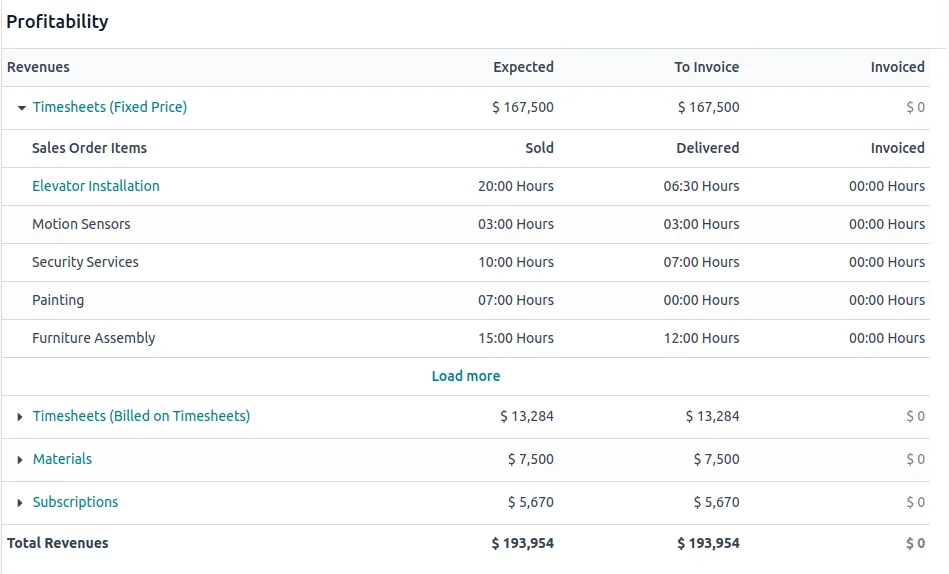
Account directors and founders track profitability without waiting for month-end.
Agencies tend to choose based on team size and how much they want in one system.
| Agency profile | Why it fits | Watch-outs | |
|---|---|---|---|
| Zoho One (CRM, Projects, Books, Sprints, Analytics) | Small to mid-size digital and social agencies | Broad suite at one price, project boards, timesheets and invoicing link well | Retainer allowance tracking needs some configuration |
| Odoo (CRM, Project, Timesheets, Accounting, Purchase) | Agencies wanting one database for work and finance | Tasks, timesheets, purchase and invoicing in the same system | Choose apps carefully to manage user licence cost |
| ERPNext | Cost-conscious agencies with technical comfort | Projects, timesheets and accounts without per-module fees | User interface is less design-team friendly out of the box |
| Dynamics 365 Business Central | Larger agency groups with several entities | Multi-company finance, jobs, Microsoft 365 and Power BI | More structure than a small creative team needs |
| Custom ERP | Agencies with a unique productized service model | Built around your exact packages and deliverables | Higher build effort and long-term ownership |
The treatment of ad spend and foreign platforms needs care. Confirm details with your tax advisor.
Marketing services to UAE clients are generally standard-rated at 5%. Tax invoices need your TRN and the prescribed fields.
Advertising and software bought from overseas suppliers may fall under the reverse charge mechanism, where the agency accounts for VAT itself. The system can apply the right tax code per supplier.
Whether media you buy for clients is your own supply or a cost passed through affects revenue and VAT. Set this up per client agreement with your advisor's guidance.
Agencies licensed in free zones should not assume 0% corporate tax; Qualifying Free Zone Person status depends on conditions such as qualifying income and substance. Clean revenue tagging supports that assessment.
General information, not tax or legal advice. Rules change; confirm current FTA, MOHRE and Ministry of Finance guidance with your advisor.
We do not quote percentages. These are the practical gains founders mention.
Account managers can show clients exactly what was delivered against the retainer.
Direct costs land on the right client, so margins reflect reality.
Extras and recharges are captured as they happen, not hunted down at month-end.
Utilization data shows when the team truly needs another designer or editor.
Agencies move quickly; most rollouts follow these ranges.
Durations are typical ranges; your plan is agreed after discovery.
We review your service packages, retainer contracts, tools in use and billing routine.
Retainer structures, task templates, timesheet rules and invoice formats are agreed.
Clients, active retainers, open projects and freelancer suppliers are loaded.
Short sessions for creatives on task boards and time logging, and for finance on billing.
We support the first full month on the system and fine-tune reports.
Sibling industries and tools agencies often compare.
We configure the system for the rules UAE businesses report against, and test it before go-live.
General information, not tax or legal advice. Confirm current requirements with the FTA, MOHRE or your advisor. See all UAE compliance guides.
On-site workshops in Dubai, Abu Dhabi and Sharjah, and remote or on-site delivery across the Northern Emirates and free zones.
Official sources and references
Facts on this page were checked against these sources in October 2026. Rules change, so confirm current requirements before acting.
Still have a question? Our consultants are happy to help.
Ask an ExpertYes. We can set allowances by deliverable type, by hours, or both. The system shows usage during the month so account managers can raise extras before the scope is exceeded.
We place time logging inside the task card they already use, with a timer or quick entry. Short, regular reminders work better than end-of-week forms.
We keep ad spend in separate accounts and recharge it according to each client agreement. Whether it is treated as your revenue or a pass-through cost is a point to agree with your tax advisor.
Yes. A client portal lets clients review drafts, approve deliverables and see invoices, which also gives you a record of approvals.
Yes. We support agencies in Dubai Media City, Dubai Internet City and other free zones and mainland areas, from our Dubai office and remotely.
Related Solutions
Related Industries
Related ERP Platforms
Related Guides
Tell us how your retainers work and we will suggest a setup that shows margin per client.
Dubai, United Arab Emirates