L
O
A
D
I
N
G


Zoho, Odoo, ERPNext, Dynamics 365 and custom ERP, delivered by one accountable team.

Built for oilfield service, engineering and support contractors: job tickets, certified equipment, rotational crews and contract costing in one system.
Oil and gas service contractors in the UAE need an ERP that links service orders and client-approved field tickets to call-off contracts, keeps equipment registers with inspection and calibration dates, plans rotational crews with mobilisation documents, and organises local spend and Emirati workforce data for In-Country Value submissions. Odoo, ERPNext, Zoho, Dynamics 365 or custom ERP can be used; SAP is not implemented.
This page covers ERP for oil and gas companies in the UAE that deliver services: well services, inspection and testing, equipment rental, engineering, fabrication support, catering and manpower for onshore and offshore sites. If you mainly buy and sell petroleum products, lubricants or spares, our page on ERP for oil and gas trading fits better.
Service contractors working for operators in Abu Dhabi, Ruwais, Fujairah and offshore fields share a set of demands. Work is ordered through call-off contracts and service orders. Each job produces a field ticket that the client must approve before you can invoice. Tools and equipment must carry valid inspection and calibration certificates. Crews rotate on schedules such as 28 days on and 28 off, and every mobilization involves permits, medicals and site inductions.
Operators also look closely at supplier data. In the UAE, In-Country Value (ICV) programmes reward suppliers that spend locally and employ UAE nationals, and the certificate depends on audited financial information. ERP will not produce a certificate for you, but clean records of local spend, headcount and payroll make the process far easier for your certifying body.

These are the gaps that cost oil and gas service companies cash and credibility.
Paper tickets signed on a rig or at a wellsite take days or weeks to reach the office. Until the client representative signs, nothing can be invoiced.
Lifting gear, pressure equipment and measuring tools need current inspection or calibration certificates. Sending an uncertified tool to site can mean rejection at the gate or a serious safety issue.
Call-off contracts list hundreds of line items: day rates, standby rates, mobilization fees and consumables. Billing the wrong rate leads to rejected invoices.
Rotations, flights, medicals, offshore survival training and site passes all need to line up. Missing one document can delay a mobilization.
Costs for tools, consumables, crew time and subcontractors arrive in different systems, so job margin is only known long after the job ends.
Operators ask for local spend, Emiratisation and financial data during prequalification and ICV reviews. Pulling it together by hand takes weeks.
The typical path for a service job under a call-off contract.
One shared database: every step updates stock, finance and reports in real time.
These modules cover most service contractors, from small inspection firms to larger multi-service groups.
Call-off contracts with every rate line, validity and purchase order limits, used to price tickets and invoices.
Each job or work order collects labour, equipment, consumables and subcontractor cost for live margin reporting.
Tools and rental equipment with serial numbers, location, utilization and depreciation.
Preventive maintenance and certificate expiry schedules that flag equipment before it is sent to site.
Rotation schedules, competencies, medicals and training certificates for field personnel.
Purchase requests, approvals and supplier records, with local versus foreign supplier flags for spend analysis.
Consumables and spares across base yards and site containers, issued to jobs.
AED, USD and other currencies for contracts and suppliers, with VAT and corporate tax reporting.
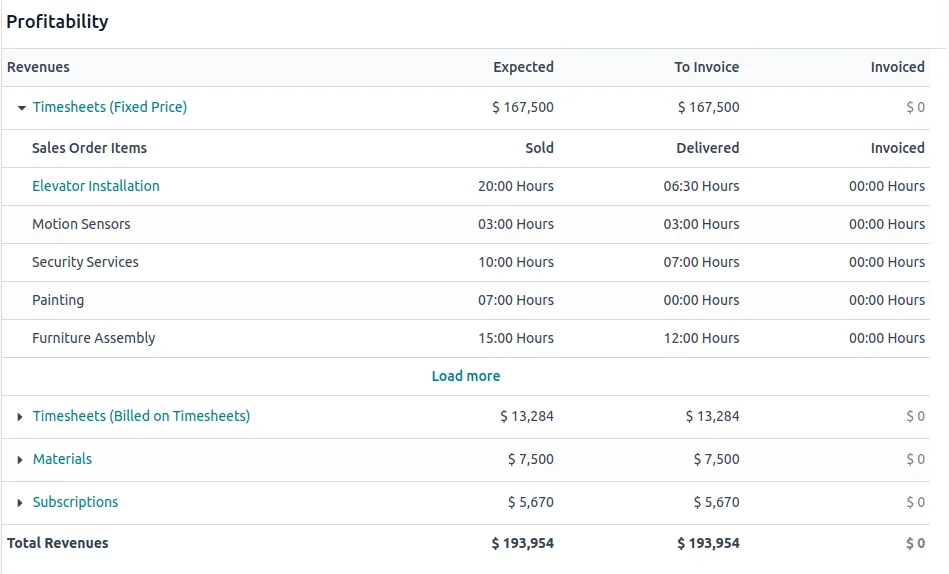
A combined view of active jobs, equipment readiness and billing status.
Our honest view of where each platform fits. We do not implement SAP; operators may use it, and we integrate with their portals and file formats where needed.
| Company profile | Often a good fit | Why |
|---|---|---|
| Specialist service firm, one or two bases | Odoo | Projects, field service, maintenance, rental and accounting together, with room to customize ticket formats. |
| Cost-focused contractor with technical team | ERPNext | Projects, asset maintenance and quality modules in an open-source stack that is easy to extend. |
| Multi-entity group or international parent | Dynamics 365 | Project accounting, fixed assets and consolidation across companies and currencies suit larger groups. |
| Small consultancy or inspection office | Zoho One | CRM, Projects, Books and Creator cover quoting, job tracking and invoicing at modest cost. |
| Unusual ticket or contract logic | Custom ERP | When operator-specific workflows dominate, a custom module or full custom build can be the cleaner route. |
Tax rules apply as for any UAE business, and operators add their own supplier expectations.
Services are generally standard-rated at 5%, but some offshore, export or designated zone supplies can be treated differently. Configure tax codes with your tax advisor and file through EmaraTax.
Corporate tax at 9% applies above AED 375,000 of taxable income. Free zone entities may qualify for 0% on qualifying income under conditions; confirm with your tax advisor.
ICV certificates are issued by approved certifying bodies based on your audited financials and other data. ERP helps by tagging suppliers as local or foreign and reporting Emirati headcount and payroll.
Larger contractors may fall into the first mandatory e-invoicing phase from 1 January 2027, with others from 1 July 2027. Check the latest Ministry of Finance and FTA guidance.
Field crews on UAE visas are paid through WPS, including rotation allowances, with gratuity accrued under UAE Labour Law.
General information, not tax or legal advice. Rules change; confirm current FTA, MOHRE and Ministry of Finance guidance with your advisor.
Goals we work toward with service contractors; outcomes depend on process discipline.
Digital field tickets signed on site reach finance the same day and convert to invoices against the right PO.
Certificate alerts stop expired tools from leaving the yard.
Cost and revenue per job are visible while the job runs, not months after.
Spend, headcount and financial data for prequalification and ICV reviews come from reports, not manual collation.
Typical ranges; multi-entity groups and integrations with client portals extend the timeline.
Durations are typical ranges; your plan is agreed after discovery.
Review contracts, ticket formats, equipment registers, rotation rules and reporting needs.
Configure contracts, projects, assets, maintenance, HR and finance, plus custom ticket layouts.
Load equipment with certificate dates, crew records, open jobs, open POs and balances.
Run complete jobs from service order to invoice with real contract rates.
Support the first month-end and first rotations closely.
Projects, asset and oil and gas pages.
We configure the system for the rules UAE businesses report against, and test it before go-live.
General information, not tax or legal advice. Confirm current requirements with the FTA, MOHRE or your advisor. See all UAE compliance guides.
On-site workshops in Dubai, Abu Dhabi and Sharjah, and remote or on-site delivery across the Northern Emirates and free zones.
Official sources and references
Facts on this page were checked against these sources in October 2026. Rules change, so confirm current requirements before acting.
Still have a question? Our consultants are happy to help.
Ask an ExpertYes, where the client accepts it. Supervisors complete the ticket on a tablet, the client representative signs on screen, and the signed ticket syncs when connectivity returns. Some operators still require their own paper or portal process, and we can attach those documents to the job.
No. ICV certificates are issued by approved certifying bodies. The ERP organizes the data they ask for, such as local supplier spend and Emirati workforce costs, so your submission is quicker and better supported.
Yes. Each tool has a record showing its current location, job, utilization and certificate status. Moves between the base and sites are logged so you know what is out and what is due back.
No. We implement Odoo, ERPNext, Zoho, Dynamics 365 and custom ERP. Many operators run SAP, and we can integrate with their supplier portals or exchange files where required.
Rotation patterns are set per employee or crew, and the system shows who is due to mobilize. Training, medical and site pass expiry dates are checked before mobilization.
It can affect VAT and corporate tax treatment, so we configure separate tax codes and entity settings. Confirm the specific treatment with your tax advisor before go-live.
Related Solutions
Related Industries
Related ERP Platforms
Talk to our team about ERP for your oilfield service, inspection or rental business.
Dubai, United Arab Emirates