L
O
A
D
I
N
G


Zoho, Odoo, ERPNext, Dynamics 365 and custom ERP, delivered by one accountable team.

Bookkeeping tells you what happened. Finance ERP tells you where cash is going, which entity is earning it, and what the group position looks like before the board meeting.
A UAE company usually needs finance ERP software rather than basic accounting once it has more than one legal entity, significant foreign currency activity, or a board wanting quick management accounts. Finance ERP runs several entities, such as a mainland LLC and a free zone company, in one database with automated intercompany invoices, consolidated statements and cash by bank, entity and currency.
Finance ERP software UAE groups choose is judged by different questions than a bookkeeping tool. A CFO wants to know the consolidated position across a mainland LLC, a free zone entity and perhaps a branch in Saudi Arabia or Oman. They want cash by bank and by currency, intercompany balances that agree on both sides, and management accounts that do not take two weeks of spreadsheet work after month end.
In practice, many UAE groups still run each entity in its own system or its own file, and the finance team stitches the picture together in Excel. Intercompany recharges are booked on one side and forgotten on the other. Corporate tax brings this into focus, because each taxable person, or a tax group if one is formed, needs taxable income it can defend.
This page is about finance control: entity structure, consolidation, cash, management reporting and tax readiness. For daily ledger work such as receivables, payables and bank reconciliation, see accounting ERP software.

The products we configure, integrate and support on projects like this one.

 Odoo Invoicing / Accounting
 ERPNext
Product names and logos are trademarks of their respective owners and are shown only to identify the software we implement.
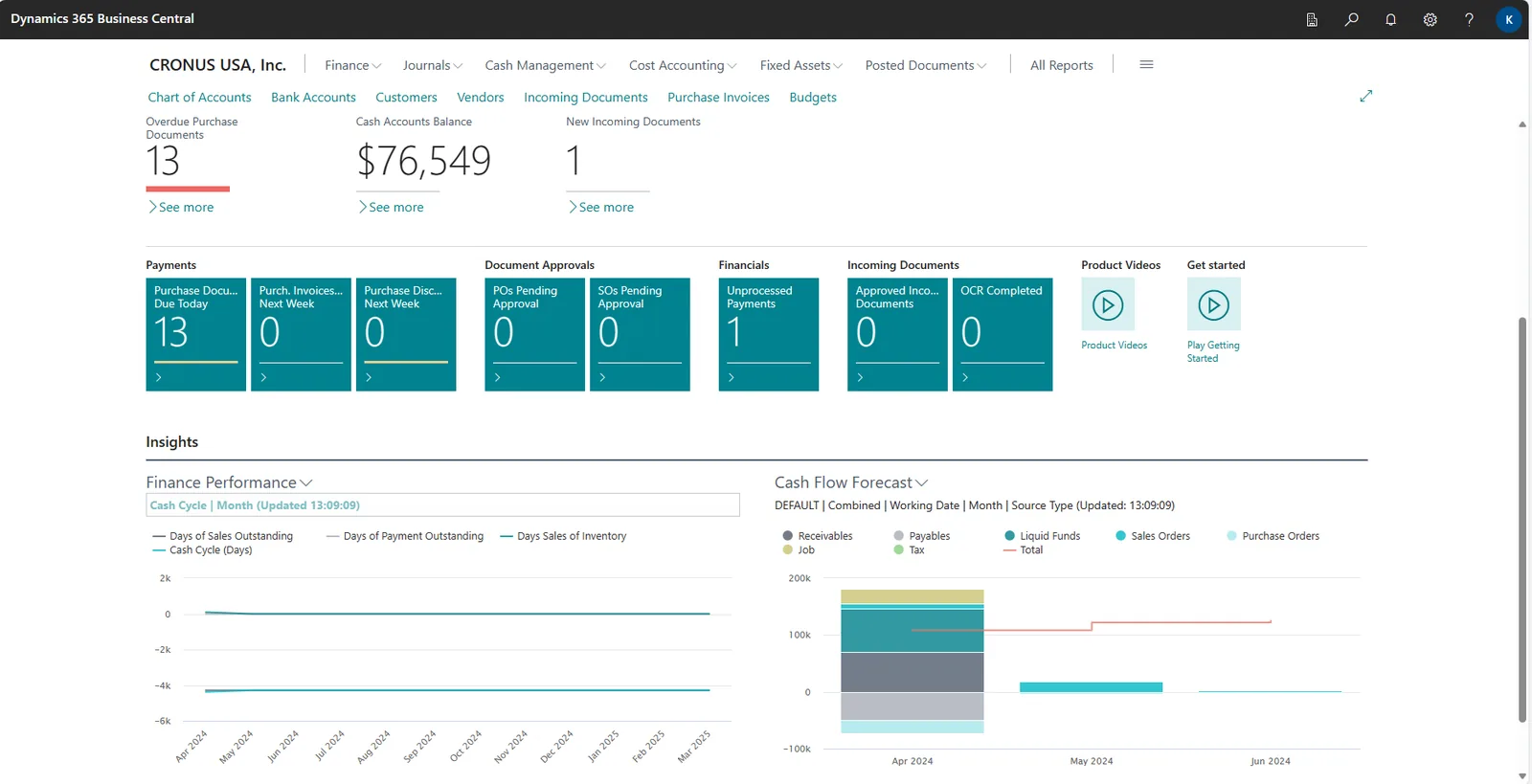
We build finance dashboards around the decisions leadership actually makes: where cash sits, which entities are profitable and what is coming due.
This is the close sequence we design for UAE groups. The aim is to move the work earlier in the month so that reporting is a review step rather than a rebuild.
One shared database: every step updates stock, finance and reports in real time.
These features separate a finance ERP from an invoicing tool. Not every company needs all six, but groups usually need most.
Each legal entity keeps its own ledger, TRN and fiscal settings while sharing customers, suppliers and products where that makes sense.
A sale from one entity creates the matching purchase in the other, so balances agree and eliminations are straightforward.
Group profit and loss and balance sheet in AED, with eliminations and currency translation handled in the system rather than in a workbook.
Bank balances, post-dated cheques, expected receipts and scheduled payments combined into a short-term cash view.
Profit by division, branch, project or product line using dimensions or analytic accounts, refreshed as transactions post.
Spending limits, payment approvals and segregation of duties so the CFO signs off what matters without approving every bill.
Group finance is where the platforms differ most. This is how we see them for UAE companies with more than one entity.
| Zoho | Odoo | ERPNext | Dynamics 365 | |
|---|---|---|---|---|
| Multi-entity model | Separate Zoho Books organizations per entity | Multi-company in one database | Multi-company in one site | Multiple companies in Business Central; Dynamics 365 Finance for larger groups |
| Intercompany | Handled through workflows or integration | Intercompany rules can mirror transactions | Inter-company invoices supported | Intercompany postings supported |
| Consolidation | Usually through Zoho Analytics or reporting layer | Consolidation reporting available; scope depends on edition and version | Consolidated financial statement reports | Built-in consolidation in Business Central; deeper in Finance |
| Management reporting | Reporting tags plus Zoho Analytics | Analytic plans and custom reports | Accounting dimensions and report builder | Dimensions, account schedules and Power BI |
| Best suited to | Groups with a few simple entities | Growing groups running operations and finance together | Groups wanting control over hosting and code | Larger groups in the Microsoft ecosystem |
Consolidation depth varies by edition and version. We verify current capability for your structure before recommending a platform.
Group reporting is only as complete as the feeds behind it. These are the connections UAE finance teams ask us for most.
Group structure affects both VAT and corporate tax. The system should hold the data your advisors need; the decisions remain theirs, so confirm treatments with your tax advisor.
Corporate tax under Federal Decree-Law No. 47 of 2022 applies at 0% up to AED 375,000 of taxable income and 9% above. Each entity, or a tax group where formed, needs clean income and adjustment data.
A Qualifying Free Zone Person can access 0% on qualifying income if conditions such as substance and the de minimis test are met. The ERP should separate qualifying and non-qualifying revenue so advisors can test it.
Intercompany charges and related-party transactions should be tagged at source so they can be documented and reviewed on an arm's length basis.
If entities are VAT grouped, intra-group supplies are treated differently from those between separately registered entities. The ERP configuration must reflect the actual registration.
Relief for revenue up to AED 3 million applies to tax periods ending on or before 31 December 2026 and excludes QFZPs and MNE group members, so most groups need full calculations.
General information, not tax or legal advice. Rules change; confirm current FTA, MOHRE and Ministry of Finance guidance with your advisor.
Explore consolidation, tax and reporting topics in more depth.
We configure the system for the rules UAE businesses report against, and test it before go-live.
General information, not tax or legal advice. Confirm current requirements with the FTA, MOHRE or your advisor. See all UAE compliance guides.
On-site workshops in Dubai, Abu Dhabi and Sharjah, and remote or on-site delivery across the Northern Emirates and free zones.
Official sources and references
Facts on this page were checked against these sources in October 2026. Rules change, so confirm current requirements before acting.
Still have a question? Our consultants are happy to help.
Ask an ExpertUsually when there is more than one legal entity, more than one currency of significance, or a board that wants management accounts quickly after month end. If the finance team spends days combining files before anyone can see group numbers, the accounting tool has been outgrown.
Yes. Each is set up as its own company with its own TRN, fiscal settings and tax configuration, while customers, products and reporting can be shared. That separation matters for corporate tax, especially if the free zone entity intends to be a Qualifying Free Zone Person.
The ERP holds the accounting profit and the tagged data needed for adjustments, such as non-deductible expenses and related-party items. The final computation and return should be prepared or reviewed by your tax advisor and filed through EmaraTax.
Subsidiaries in Saudi Arabia, Oman or India can sit in the same system with their own localization, or remain on a local system that feeds group reporting. We recommend the option that keeps local compliance simple while still giving the CFO a consolidated view.
A group with two to four entities often takes eight to fourteen weeks, depending on intercompany volume, consolidation needs and how clean the opening balances are. We phase it so one entity goes live first and others follow once the model is proven.
Related Solutions
Related Industries
Related ERP Platforms
Related Guides
Share your entity structure with us and we will outline how a finance ERP would consolidate it.
Dubai, United Arab Emirates