L
O
A
D
I
N
G


Zoho, Odoo, ERPNext, Dynamics 365 and custom ERP, delivered by one accountable team.

One system for water bottlers, juice processors and soft drink plants: formulations, filling lines, shelf life, returnable bottles and daily route sales.
An ERP for beverage manufacturing in the UAE should control recipes and blends with yield tracking per batch, apply FEFO picking and expiry alerts from plant to van, and track returnable 5-gallon bottles, crates and coolers like customer deposits. Odoo, ERPNext, Dynamics 365 and Zoho can serve water bottlers, juice processors and soft drink plants, depending on plant type.
Choosing an ERP for beverage manufacturing in the UAE starts with a simple fact: a beverage plant makes money in high volume and low margin. A bottled water company in Al Quoz, a juice processor in Dubai Investment Park or a carbonated drinks plant in Sharjah runs thousands of cases a day, each with a short shelf life and a cost that moves with sugar, concentrate, PET resin and diesel prices. Small errors in yield or expiry rotation add up quickly.
A beverage plant also sells differently from most factories. Much of the volume leaves on vans that serve groceries, offices, homes and HORECA customers on fixed routes, often with returnable 5-gallon bottles, crates and coolers that must be tracked like customer deposits. Production, the warehouse and the sales fleet all depend on the same stock numbers.
We implement Odoo, ERPNext, Microsoft Dynamics 365 and Zoho for UAE manufacturers, and build custom modules where a standard app does not fit. This page explains how a beverage ERP should handle formulation, filling, quality, shelf life, route sales and UAE tax, and which platform tends to suit which type of plant. For the wider picture of factory systems, see our ERP for manufacturing companies overview.
These are the issues we hear most often from bottling and drinks plants before they move to a proper ERP.
Sugar, concentrate and water go into a mixing tank, but the number of cases filled rarely matches the theoretical yield. Without batch-level consumption records, losses from overfill, line flushing and rejects stay hidden in the cost of goods.
Fresh juices and dairy-based drinks may have days or weeks of shelf life, not months. If the warehouse picks by habit instead of first-expiry-first-out, stock expires on shelves and retailers return it for credit.
Five-gallon water bottles, glass bottles and plastic crates carry real value, yet many plants track them on paper route sheets. Unreturned containers become an unrecorded cost and a source of disputes with customers.
Drivers load in the morning, sell, collect cash and return empties in the evening. When van stock, invoices and cash are reconciled in spreadsheets, shortages surface days later and are hard to assign.
Certain carbonated, energy and sweetened drinks fall under UAE Excise Tax as well as VAT, and the basis for the excise calculation has changed over time. Manual calculations on price lists create errors that are costly to correct after filing.
A typical bottling flow from planning to cash, with each step recorded against a batch or lot number.
One shared database: every step updates stock, finance and reports in real time.
Most beverage manufacturers need the following building blocks. The exact app names differ by platform.
Recipes for syrup and finished drinks with scalable quantities, plus packaging BoMs for bottle, cap, label and shrink film per SKU.
Work orders per line with planned versus actual output, downtime reasons and changeover time between flavors or pack sizes.
Every pallet carries a lot with production and expiry dates, so recalls and FEFO picking work from the same data.
Brix, pH, CO2 volume and microbiology checks recorded per batch, with stock held in quarantine until QC releases it.
Mobile invoicing on the van, load and unload sheets, cash collection and route profitability reports.
Deposits for bottles, crates and coolers posted per customer, with balances visible to drivers and the finance team.
Reorder planning for concentrate, sugar, preforms, caps and labels based on the production plan and supplier lead times.
VAT and excise-aware invoicing, cost roll-ups per SKU and margin by channel, route and customer.
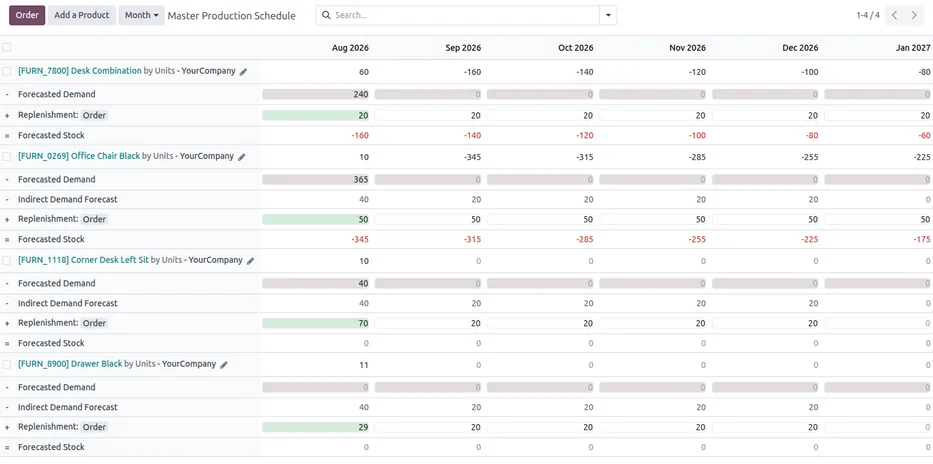
A production dashboard pulls line output, quality holds and stock age into one screen so the morning meeting starts from facts.
There is no single best answer. The right platform depends on volume, the number of routes, and how much process control you need.
| Company profile | Usual fit | Why it works | Watch-outs |
|---|---|---|---|
| Single-line water bottler with home and office delivery | Zoho (Inventory, Books, CRM) or Odoo | Strong on subscriptions, routes and customer deposits with modest production needs | Zoho Inventory is not a full MRP; recipe costing may need Zoho Creator |
| Juice or soft drink plant with 2-5 lines | Odoo Manufacturing or ERPNext | BoMs, work centers, lot and expiry tracking and quality checks in one database | Van sales usually need a mobile app or extension configured |
| Multi-site plant with export and key accounts | Dynamics 365 Business Central or Supply Chain Management | Deeper planning, multi-entity finance and process manufacturing options in SCM | Longer implementation and higher licence cost |
| Plant with unusual mixing or dosing equipment | ERPNext or custom ERP | Open data model makes PLC or scale integration easier | Needs clear ownership of custom code and documentation |
We implement Zoho, Odoo, ERPNext, Dynamics 365 and custom ERP. We do not implement SAP or NetSuite.
An ERP does not make you compliant on its own, but it can be configured so the right data is captured at the right step. Confirm the rules for your products with your tax advisor.
Carbonated, energy and sweetened drinks can fall under UAE Excise Tax, and the calculation basis has been revised before. The ERP should hold excise attributes per SKU, compute excise separately from VAT and support the excise return data your advisor needs.
Tax invoices must show your TRN and the prescribed fields. Van sales devices should print or send compliant tax invoices, and returns should be mapped to the VAT return filed through EmaraTax.
Under Ministerial Decisions No. 243 and 244 of 2025, businesses with revenue of AED 50 million or more must issue e-invoices through an Accredited Service Provider from 1 January 2027, and smaller businesses from 1 July 2027. Check the latest Ministry of Finance and FTA guidance, as dates have been amended before.
Municipal food safety authorities and buyers expect batch traceability, label data and recall capability. Keeping batch, ingredient lot and QC results in the ERP makes a recall exercise a report rather than a search.
General information, not tax or legal advice. Rules change; confirm current FTA, MOHRE and Ministry of Finance guidance with your advisor.
Results depend on your starting point and discipline, so we describe the kind of improvement rather than promise numbers.
FEFO picking and aging alerts help sales push short-dated stock before it becomes a credit note.
Comparing theoretical and actual cases per batch shows where concentrate and product are lost.
Van stock, invoices, empties and cash close daily instead of at month end.
Excise and VAT are calculated from item master data rather than typed by hand.
Durations are typical ranges for a single-site plant and vary with scope, data quality and the number of routes.
Durations are typical ranges; your plan is agreed after discovery.
We map recipes, lines, warehouse zones, route structure and container deposit rules.
BoMs, work centers, lot and expiry rules, excise attributes and route sales setup.
Items, customers, opening stock by lot, open container balances and ledgers.
Trial batches, mock routes and a full day's reconciliation before go-live.
On-site support during the first production and sales cycles, then ongoing support.
Explore platforms, sister industries and modules that matter to drinks producers.
We configure the system for the rules UAE businesses report against, and test it before go-live.
General information, not tax or legal advice. Confirm current requirements with the FTA, MOHRE or your advisor. See all UAE compliance guides.
On-site workshops in Dubai, Abu Dhabi and Sharjah, and remote or on-site delivery across the Northern Emirates and free zones.
Official sources and references
Facts on this page were checked against these sources in October 2026. Rules change, so confirm current requirements before acting.
Yes. Odoo, ERPNext and Dynamics 365 can run production, warehouse and route sales in one database, usually with a mobile app for drivers. Zoho works well for delivery-led water companies that do light production. The important part is that van stock is a real warehouse location in the system.
Containers are set up as tracked items, and each delivery records bottles delivered and empties collected. The customer's container balance and deposit are visible on the account, so drivers can see who is holding more bottles than agreed.
It can be configured to calculate excise per SKU from item attributes and to show it separately from VAT. Because excise rules for sweetened drinks have changed before, the rates and basis should be confirmed with your tax advisor and reviewed when the FTA updates guidance.
Yes, if lot tracking is enabled on raw materials and finished goods. A trace report then shows which supplier lots went into a production batch and which customers received cases from it, which is what a recall exercise needs.
The FTA maintains a Tax Accounting Software Register of accredited tax accounting software. Check the current register for any specific product you are considering. We configure the ERP to support tax invoices, VAT return mapping, audit trails and the FTA Audit File.
Tell us how your business runs today and where it gets stuck. We'll recommend the right platform, outline the implementation approach and give you a realistic timeline, with no obligation.
Dubai, United Arab Emirates