L
O
A
D
I
N
G


Zoho, Odoo, ERPNext, Dynamics 365 and custom ERP, delivered by one accountable team.

For blenders and formulators of paints, coatings, adhesives, cleaning products, lubricants and construction chemicals across the UAE.
An ERP for chemical manufacturing in the UAE must handle process manufacturing: versioned formulas held as percentages and scaled to batch size, raw material issue by lot, in-process and final QC, certificates of analysis, and hazardous stock by storage zone. Odoo or ERPNext often suit small blenders and mid-sized paint plants, while larger multi-site chemical groups may prefer Microsoft Dynamics 365.
An ERP for chemical manufacturing in the UAE has to think in kilograms, litres and percentages, not in screws and sub-assemblies. Plants in Jebel Ali, Sharjah's industrial areas, Hamriyah and Ras Al Khaimah blend resins, solvents, pigments, surfactants and additives into products that are sold by the drum, pail, IBC or tanker. One raw material can be bought by weight, stored by volume and issued by percentage of a batch.
Customers in construction, oil and gas, facility management and export markets want a certificate of analysis with every shipment and expect the same shade, viscosity or solids content from batch to batch. Regulators and civil defence inspectors want to know what hazardous materials are on site and where. That puts quality records and stock location at the centre of the system.
We implement Odoo, ERPNext, Microsoft Dynamics 365 and Zoho, and build custom extensions where chemistry demands it. Below we cover formulation control, batch quality, packing, hazardous inventory and the UAE compliance points that a chemical ERP should support. If you also run a trading arm for imported chemicals, our page on ERP for import and export companies covers that side.
Most chemical manufacturers we meet run production from spreadsheets of formulas and paper batch cards. These are the gaps that causes.
A chemist adjusts a formula to use an alternative surfactant, and the spreadsheet is overwritten. Months later nobody can say which version produced a complaint batch.
Solvents are bought in litres, stored in kilograms and invoiced per drum. Without density-aware conversions, stock and costs drift every time a tank is dipped.
Lab results are written on a batch card and then retyped into a Word template for the CoA. Typing errors reach customers and the original readings are hard to find during an audit.
When a batch fails viscosity or pH, it is adjusted, blended back or downgraded. If the ERP cannot record rework, material usage and cost per batch become unreliable.
Flammable solvents, corrosives and oxidisers need segregated storage. A stock list that does not show hazard class and location makes inspections and emergency planning harder.
The typical make-to-order or make-to-stock flow in a blending plant, with QC gates built in.
One shared database: every step updates stock, finance and reports in real time.
These modules cover the core of a formulator's operation, whether you make paints, detergents or construction chemicals.
Formulas held as percentages with version history, approval status and scaling to any batch size.
Batch tickets with charge sequence, mixing times and actual quantities used per raw material lot.
Test specifications per product, in-process and final results, pass or fail status and a generated certificate of analysis.
Lot numbers on every raw material and finished drum, with retest and expiry dates for reactive or perishable products.
One bulk batch filled into several pack sizes, with by-products and co-products recorded and costed correctly.
Hazard class, UN number, SDS document and storage zone stored on the item so warehouse and logistics see them.
Approved supplier lists, incoming inspection and supplier CoA attached to the goods receipt.
Standard and actual batch costs, including rework and packaging, compared with the selling price by customer.
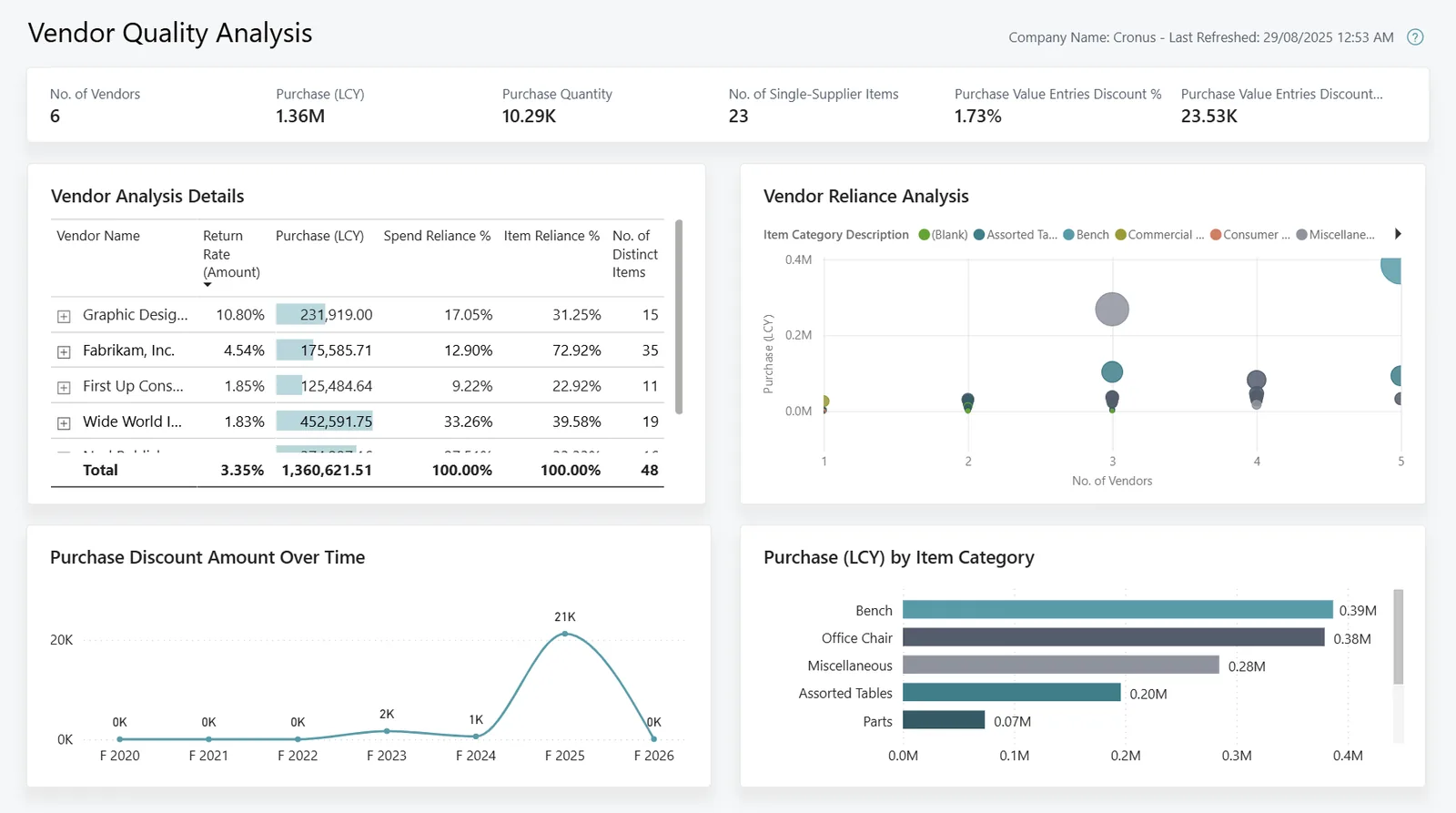
A quality dashboard brings lab results, holds and supplier issues together, so the QC manager and plant manager work from one screen.
Chemical plants range from a single mixing vessel to multi-reactor sites. Here is how the platforms we implement tend to fit.
| Company profile | Usual fit | Strengths | Points to check |
|---|---|---|---|
| Small blender of cleaning products or lubricants | Odoo or ERPNext | BoMs, lot tracking and quality checks at a reasonable cost of ownership | Percentage-based formulas and CoA layouts need configuration |
| Paints, coatings or construction chemicals with many SKUs | Odoo Manufacturing with Quality, or ERPNext | Variants for colour and pack size, quality control points, multi-warehouse | Tinting and shade matching may need custom fields |
| Multi-plant or export-focused process manufacturer | Dynamics 365 Supply Chain Management | Process manufacturing features such as formulas, batch attributes and co-products | Larger project and licence budget; needs strong internal ownership |
| Trading-led company with light repacking | Zoho Inventory with Zoho Creator | Batch tracking, composite items and simple repack orders | Not designed for complex formulas or reactor scheduling |
We implement Zoho, Odoo, ERPNext, Dynamics 365 and custom ERP. We do not implement SAP or NetSuite, though we migrate data from them.
The ERP should store the data that permits, customs and tax filings depend on. Specific obligations vary by emirate and product, so confirm them with your advisors and the relevant authority.
Emirate-level civil defence, municipality and environment authorities can require permits for storing and handling hazardous chemicals. The ERP can hold permit numbers, expiry dates and storage limits and flag renewals.
Some chemicals need import permits or are restricted. Recording HS codes, permit references and country of origin on items and purchase orders keeps clearance documents consistent.
Domestic sales carry 5% VAT on a tax invoice showing your TRN, while exports may be zero-rated where conditions are met. E-invoicing through an Accredited Service Provider becomes mandatory from 1 January 2027 for businesses with revenue of AED 50 million or more and from 1 July 2027 for others; check the latest Ministry of Finance and FTA guidance.
Corporate tax is 9% on taxable income above AED 375,000. A plant in a free zone may be a Qualifying Free Zone Person on qualifying income if conditions are met, so keeping free zone and mainland revenue separate in the ledger matters. Confirm with your tax advisor.
General information, not tax or legal advice. Rules change; confirm current FTA, MOHRE and Ministry of Finance guidance with your advisor.
We avoid promising percentages. These are the improvements that tend to follow a well-run implementation.
Approved formula versions and recorded charge quantities reduce variation between operators and shifts.
CoAs are generated from recorded test results, which removes retyping and speeds up dispatch.
Actual consumption, rework and packaging are captured per batch, so margins reflect reality.
Hazard class and location for every lot can be listed in minutes when an inspector or insurer asks.
Typical ranges for one site; formula complexity and data clean-up drive the actual duration.
Durations are typical ranges; your plan is agreed after discovery.
Formula review, QC specifications, packaging matrix, storage zones and permit records.
Items with units and density, formula versions, test specifications and CoA templates.
Production, quality, warehouse, purchasing and finance, plus scales or lab instruments if needed.
Real batches run in the new system alongside the old batch cards to prove the numbers.
Cut-over of opening lots, on-site support for the first production weeks, then ongoing support.
Platforms, modules and sister industries that chemical producers often review.
We configure the system for the rules UAE businesses report against, and test it before go-live.
General information, not tax or legal advice. Confirm current requirements with the FTA, MOHRE or your advisor. See all UAE compliance guides.
On-site workshops in Dubai, Abu Dhabi and Sharjah, and remote or on-site delivery across the Northern Emirates and free zones.
Official sources and references
Facts on this page were checked against these sources in October 2026. Rules change, so confirm current requirements before acting.
Yes. Formulas can be held as percentages or per base quantity and scaled to the batch size on the production order. On some platforms this is standard, and on others it is a small configuration or extension. Version history should be switched on so every batch links to the formula used.
Test specifications are defined per product, QC staff record results against the batch, and a CoA template pulls those results with the lot number and dates. The certificate is then attached to the delivery or emailed with the invoice.
Yes. The item can carry a base unit and conversion factors, including density for liquids. Purchase, stock and sales units can differ, and the ERP converts quantities and costs consistently.
Yes. Customer-supplied materials can be received into a separate location, consumed on the batch and invoiced as a conversion service, so their stock is never mixed with yours in the books.
Odoo and ERPNext are often a good fit for mid-sized paint and coatings plants because they handle variants, lots and quality checks well. Larger multi-site groups may prefer Dynamics 365. We recommend after reviewing your formulas, volumes and reporting needs.
Related Solutions
Related Industries
Related ERP Platforms
Call +971 55 145 3265 or email contact@uaeerpexperts.com to discuss your chemical plant with our consultants.
Dubai, United Arab Emirates