L
O
A
D
I
N
G


Zoho, Odoo, ERPNext, Dynamics 365 and custom ERP, delivered by one accountable team.

Contractors rarely lose money on site alone; they lose it in unbilled variations, unreleased retention and unmatched subcontractor claims. We set up ERP to track the commercial side of every contract.
An ERP for contracting companies in the UAE follows each contract from tender to final account. One contract record holds award value, variations, certified amounts and retention. Payment applications are compared with consultant certificates line by line, bank guarantees are tracked with expiry reminders, and subcontractor work orders link to the main contract, alongside project accounting and WPS payroll for site labour.
ERP for contracting companies in the UAE has to follow the contract, not just the cost. A general contractor in Dubai, a building contractor working for developers in Abu Dhabi, or a multi-trade firm in Sharjah juggles tenders, letters of award, payment applications, consultant certifications, retention, advance payments, performance guarantees and back-to-back subcontracts, often across a dozen live projects at once.
Site progress might look fine while cash flow is in trouble. Payment certificates arrive late and below the amount applied for, retention is held for years, guarantees renew without anyone checking whether they can be released, and subcontractors bill against work that has not yet been certified upstream. Without a single record per contract, the commercial manager, the accounts team and the project manager each work from different numbers.
We implement Odoo, ERPNext, Dynamics 365 Business Central and Zoho for contractors and build focused extensions for payment applications and retention where needed. This page focuses on contract and commercial control; for site operations, equipment and labour, see our ERP for construction companies page and project management ERP.

These are the issues commercial and finance teams raise most often in our first meetings.
Contractors apply for one amount and receive a certificate for less, sometimes months later. Without line-by-line comparison, disputed items are forgotten and never recovered.
Retention withheld by clients and retention held from subcontractors sit in general accounts. Release dates after handover and the defects liability period pass without anyone invoicing.
Advance payment and performance guarantees carry bank charges. When nobody tracks reduction and release conditions, the company keeps paying for guarantees it no longer needs.
Site instructions change scope, but variation orders are not raised, priced or tracked until the final account, when evidence is hard to gather.
Subcontractors are certified based on their claims rather than on what the main client has certified, exposing the contractor to paying for work it has not been paid for.
Profit per project is reported, but the cash position, which decides whether payroll can be met, is rebuilt manually every month.
Each stage builds on the previous one, so the final account is assembled from records rather than reconstructed.
One shared database: every step updates stock, finance and reports in real time.
Commercial control relies on these modules working from the same contract and BOQ structure.
BOQ-based estimates with rates for material, labour, plant and subcontract, and conversion of a won tender into a project budget.
Contract value, BOQ items, quantities and rates stored per project, with approved variations added as new or revised lines.
Cumulative payment applications by BOQ item, with advance recovery, retention deduction and previous certificates calculated automatically.
Subcontract orders, work done certificates, back-charges, retention held and payments, linked to main-contract BOQ items.
Bid bonds, advance payment guarantees and performance bonds recorded with bank, value, margin and expiry, plus release reminders.
Costs posted by project and cost code, with committed costs, actuals and forecast to complete reported against budget.
Material requests from site, quotation comparison and purchase orders charged against the right project budget line.
Site labour, timesheets, accommodation and WPS payroll with labour cost allocated to projects.
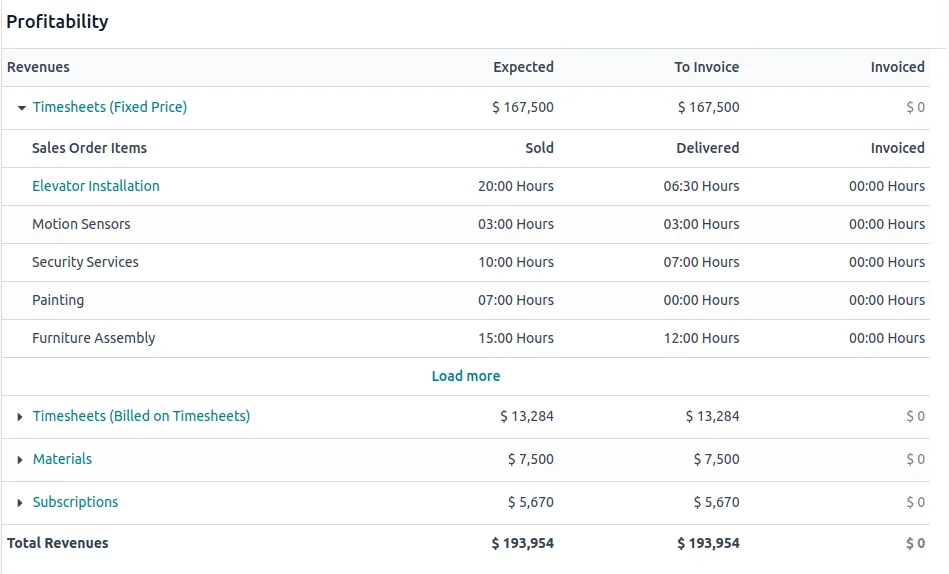
Directors want to see every contract's commercial position on one screen.
Contracting firms range from small fit-for-purpose operations to large multi-project groups.
| Company profile | Often a good fit | Why | Watch out for |
|---|---|---|---|
| Small contractor with a few projects | Zoho Books with Zoho Projects | Project-based invoicing, expense tracking and simple budgets at low cost | Retention and payment applications need custom fields or Zoho Creator |
| Mid-size general contractor | Odoo (Project, Accounting, Purchase) with progress billing extensions | Analytic accounts per project, purchase control and a single database | BOQ billing and retention are usually added through configuration or a module |
| Contractor wanting ownership of code | ERPNext with construction customizations | Projects, purchasing and accounting dimensions on an open-source base | Plan BOQ and certificate design upfront to avoid rework |
| Large or multi-company contracting group | Dynamics 365 Business Central | Projects (jobs) with WIP, multi-company finance and Power BI reporting | Commercial features like guarantees may need extensions or partner apps |
We implement Zoho, Odoo, ERPNext, Dynamics 365 and custom ERP, and recommend based on your contract volume and structure.
Contracting creates specific timing questions for tax. These notes explain what the ERP supports; confirm the treatment of your contracts with your tax advisor.
Construction contracts are often treated as continuous supplies, where the timing of VAT depends on payment dates, invoices and certificates. Retention timing also needs care. The ERP can issue tax invoices from certificates and track retention separately, but the rules applied should be confirmed with your advisor.
Corporate tax applies at 9% above AED 375,000 of taxable income. Revenue recognition on long-term contracts affects taxable income, so project accounting and WIP should be set up in line with your accounting policies.
Contractors employ large site workforces whose salaries must go through the Wage Protection System. The ERP generates the SIF from payroll and allocates labour cost to projects.
B2B invoices to developers and main contractors will move to Peppol-based e-invoicing through Accredited Service Providers, mandatory in phases from 2027. Check the latest Ministry of Finance and FTA guidance.
General information, not tax or legal advice. Rules change; confirm current FTA, MOHRE and Ministry of Finance guidance with your advisor.
These are the outcomes clients typically target; actual results depend on data discipline.
Disputed and uncertified items stay visible until they are resolved, instead of being forgotten.
Release dates trigger reminders and draft invoices, so retention does not sit unclaimed.
Guarantees are reduced or released as soon as conditions are met.
Expected receipts from certificates and payments to subcontractors feed a realistic cash forecast.
Ranges assume a mid-size contractor; live projects are migrated in a controlled way.
Durations are typical ranges; your plan is agreed after discovery.
We review contracts, payment application formats, subcontract terms and reporting needs.
Contract, BOQ, billing, retention and guarantee features are configured or developed.
Running contracts are loaded with cumulative certified values, retention and open commitments.
One month's payment applications are produced in both old and new systems and compared.
Full use across projects, with support for new contract types and reports.
Construction, project and platform pages connected to contracting.
We configure the system for the rules UAE businesses report against, and test it before go-live.
General information, not tax or legal advice. Confirm current requirements with the FTA, MOHRE or your advisor. See all UAE compliance guides.
On-site workshops in Dubai, Abu Dhabi and Sharjah, and remote or on-site delivery across the Northern Emirates and free zones.
Official sources and references
Facts on this page were checked against these sources in October 2026. Rules change, so confirm current requirements before acting.
Yes. We set up the BOQ with your contract's structure and design a payment application print format that shows previous, current and cumulative values, advance recovery and retention in the layout your consultants expect.
Retention deducted on each certificate is posted to a retention receivable account per project. Retention held from subcontractors is tracked as a payable. Release dates linked to handover and the defects liability period trigger reminders.
Yes. Guarantees are recorded with bank, type, amount, margin, issue and expiry dates and linked to the project. Reports show upcoming expiries and guarantees eligible for reduction or release.
Site instructions are recorded as variation requests, priced and submitted, then added to the contract sum when approved. Pending variations stay visible so they can be followed up before the final account.
Yes. We load each live contract with its BOQ, cumulative certified quantities, retention and open subcontract balances, so the next payment application continues from the right figures.
Related Solutions
Related Industries
Related ERP Platforms
Send a recent payment application and subcontract certificate and we will show how ERP would handle both.
Dubai, United Arab Emirates