L
O
A
D
I
N
G


Zoho, Odoo, ERPNext, Dynamics 365 and custom ERP, delivered by one accountable team.

Distributors win on reach and reliability. An ERP that connects the warehouse, the van and the brand owner keeps both promises measurable.
An ERP for distribution companies in the UAE must follow goods from a central warehouse, often in Jebel Ali, Dubai Investment Park or Sharjah, out to hundreds of outlets on fixed routes. It needs van sales invoicing that works offline, driver signature capture, route-level returns and principal-specific sell-in and stock reports, alongside UAE VAT-compliant invoicing and accurate stock across locations.
An ERP for distribution companies in the UAE has to follow goods out of the warehouse and onto the road. Distributors hold agency or distribution rights for brands, keep stock in a central warehouse, often in Jebel Ali, Dubai Investment Park or Sharjah industrial areas, and deliver to hundreds of outlets across the emirates on fixed routes.
That creates needs a plain accounting package cannot meet. Salesmen need to invoice from the van, drivers need to capture signatures, and the brand owner (the principal) wants weekly sell-in and stock reports in their own format. Meanwhile finance needs cash collected on the route to match what the van loaded in the morning.
We implement distribution flows on Zoho, Odoo, ERPNext and Dynamics 365 Business Central, with mobile apps for vans and drivers. Our ERPNext for distribution and Dynamics 365 for distribution pages go deeper into each platform.
Most distributors we speak to have outgrown spreadsheets on at least one of these fronts.
Goods loaded in the morning, sold, returned or damaged during the day rarely add up by evening. Shortages get written off because nobody can trace them.
Salesmen collect cash and cheques from shops. Without a mobile receipt that posts to the ERP, collections are reconciled from paper days later.
Each brand owner asks for sales by outlet, SKU and region in a different layout. Staff spend days every month building these from exports.
Promotional support, price differences and damaged goods are claimable from the principal, but only if every claim is backed by invoice-level data. Many go unclaimed.
Customers say goods were short or never arrived. Without a signed, time-stamped proof of delivery, the distributor usually issues a credit note.
This is the loop the ERP and its mobile apps run every working day.
One shared database: every step updates stock, finance and reports in real time.
Distribution projects lean heavily on mobile and warehouse modules alongside core finance.
Offline-capable mobile invoicing from van stock, with tax invoices printed on a portable printer or shared digitally.
Assign outlets to routes and days, track visit compliance and record missed visits with a reason.
Driver app with delivery lists, customer signature, photos and GPS time stamps posted back to the order.
Central warehouse, branch stores and each van as a separate location with transfers between them.
Tag items and sales by principal, generate brand-specific reports and track claims and agreed support.
Route collections posted from the app and settled against the cashier at the end of the day.
Replenishment orders by principal with lead times and minimum order quantities.
Receivables, payables, bank and VAT reporting that pick up every van and warehouse transaction.
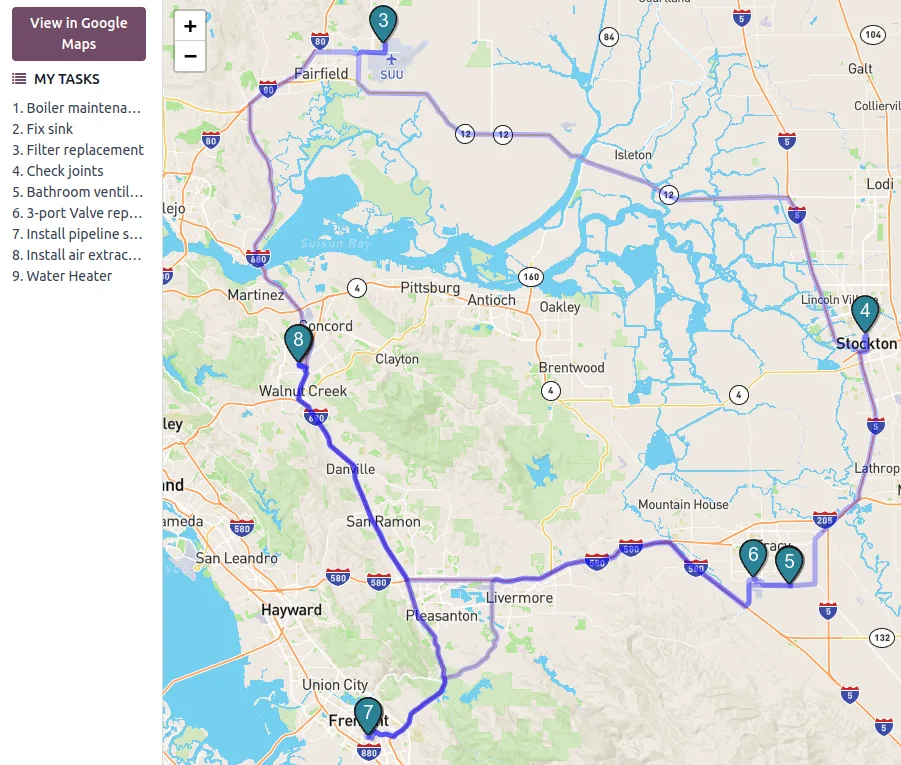
Operations managers want to know what happened on the road today, not last month.
Platform choice for distributors often comes down to the mobile layer and how many principals you represent.
| Distributor profile | Often a good fit | Notes |
|---|---|---|
| Small distributor, a few vans, one or two principals | Zoho Inventory, Zoho Books and a Zoho Creator van app | Low running effort; the van app is usually built to fit your route process. |
| Mid-size distributor with many principals and routes | Odoo | Inventory, sales and field apps in one database; third-party or custom van sales apps are common. |
| Distributor wanting open source and full control | ERPNext | Flexible doctypes for principal reporting; mobile van sales usually needs custom development. |
| Large distributor with group entities and strict finance | Dynamics 365 Business Central | Strong finance and warehouse; van sales typically comes from a partner add-on. |
| Distributor with its own routing logic or devices | Custom mobile app on top of any platform | We integrate the app through APIs so the ERP stays the record of truth. |
For a buying-guide view, see best distribution ERP in the UAE.
These are the areas where distribution flows touch UAE regulation. Confirm specific treatment with your tax advisor.
Invoices printed or sent from a mobile device still need your TRN, sequential numbering and the prescribed VAT fields. The app pulls these from the ERP rather than storing its own numbering.
Promotional free goods and samples can have VAT consequences depending on value and arrangement. The ERP records them as separate transactions so your advisor can review the treatment.
Most outlet sales are B2B, so PINT AE e-invoicing through an Accredited Service Provider will apply in the 2027 phases. Van invoicing needs to feed the same e-invoicing pipeline. Check the latest Ministry of Finance and FTA guidance for dates.
Route staff are paid through WPS with a Salary Information File. Incentives tied to route sales can be calculated in the ERP and passed to payroll.
General information, not tax or legal advice. Rules change; confirm current FTA, MOHRE and Ministry of Finance guidance with your advisor.
Benefits depend on adoption by drivers and salesmen, which is why we plan field training carefully.
Load, sales, returns and cash settle the same evening instead of drifting for weeks.
Invoice-level data makes principal claims easier to prepare and harder to reject.
Signed, time-stamped proof of delivery answers most 'never received' complaints.
Brand reports are generated from saved templates rather than rebuilt from spreadsheets.
Distribution projects often run 12-18 weeks because mobile apps and field training add time.
Durations are typical ranges; your plan is agreed after discovery.
Document routes, outlets, principals, claim types and report formats.
Configure warehouses, van locations, pricing, credit and principal tagging.
Set up or build van sales and delivery apps, printers and offline sync.
Run one or two routes live, fix issues and refine the settlement process.
Bring remaining routes and principals onto the system in waves.
Platform-specific distribution pages and related operations topics.
We configure the system for the rules UAE businesses report against, and test it before go-live.
General information, not tax or legal advice. Confirm current requirements with the FTA, MOHRE or your advisor. See all UAE compliance guides.
On-site workshops in Dubai, Abu Dhabi and Sharjah, and remote or on-site delivery across the Northern Emirates and free zones.
Official sources and references
Facts on this page were checked against these sources in October 2026. Rules change, so confirm current requirements before acting.
Good van sales apps work offline and sync when signal returns, which matters in some industrial areas and remote routes. We check offline behaviour during the pilot before rolling out to all vans.
Yes. Sales and stock are tagged by principal, and report templates are saved per brand. Many distributors schedule them to email automatically each week.
Returns are recorded in the app against the original invoice where possible, with a reason code. Damaged stock goes to a separate location for inspection, claim or write-off.
Yes. Logistics companies move other people's goods for a fee, while distributors own the stock and sell it. See ERP for logistics companies if you run a 3PL or transport business.
We work from our Dubai office and support distributors across all seven emirates on-site and remotely, including route pilots in Sharjah, Abu Dhabi and the northern emirates.
Related Solutions
Related Industries
Related ERP Platforms
Tell us about your routes and principals and we will propose a pilot that proves the van-to-ERP flow.
Dubai, United Arab Emirates