L
O
A
D
I
N
G


Zoho, Odoo, ERPNext, Dynamics 365 and custom ERP, delivered by one accountable team.

Plan crews, deliver recurring and one-off jobs, control chemical and consumable stock, and invoice accurately from one system.
An ERP for cleaning companies in the UAE runs commercial contracts and residential bookings from one system. Recurring contracts for offices, malls and towers generate visits automatically, while online and WhatsApp bookings become dispatched jobs. Each job carries a schedule, crew, checklist, materials allowance and invoice, and chemical and consumable usage is tracked per site to show real cost.
An ERP for cleaning companies in the UAE has to handle two very different kinds of work at once. On one side are commercial contracts: offices, malls, schools and residential towers cleaned daily or weekly under an annual agreement. On the other are residential bookings: a villa deep clean in Arabian Ranches, a move-out clean in JLT or a sofa shampoo in Al Nahda, often booked the same day through WhatsApp or an app.
Both kinds of work depend on the same crews, vans and supplies. When schedules are kept in a group chat and stock in a storeroom notebook, crews arrive late, jobs overlap and nobody knows how many litres of floor cleaner each contract actually uses. Pricing a new tender becomes guesswork because you cannot see your real cost per square foot or per visit.
We set up ERP so that every job, recurring or one-off, has a schedule, a crew, a checklist, a materials allowance and an invoice. Managers see tomorrow's route on a map, supervisors close jobs with photos, and finance invoices without chasing anyone. If your business has grown into full facility services, our facility management ERP page covers maintenance contracts and technical services.

These are the operational gaps we see most often in UAE cleaning businesses.
Residential bookings are squeezed in around contract shifts without a shared calendar. Crews end up promised to two places at once, and the client who waits is the one who cancels next time.
Chemicals, trash bags, paper and microfiber cloths go out of the store with no record of which site used them. Consumption creeps up and contract margins shrink without anyone noticing.
Building managers dispute whether a scheduled clean happened or met the standard. Without timestamped photos and checklists, you are left arguing over memory.
Commercial bids are priced on rule of thumb. Without actual labour hours and material cost per site, it is hard to tell which contracts to renew and which to walk away from.
Crews move between sites in company vans across traffic-heavy routes. Unplanned routes waste hours that are paid but never billed.
Monthly contract invoices wait for supervisors to confirm extras such as additional deep cleans. Late invoicing pushes cash collection out by weeks.
Recurring contracts and one-off bookings follow the same path once they enter the system.
One shared database: every step updates stock, finance and reports in real time.
A cleaning business does not need heavy manufacturing or warehouse features. It needs these.
Drag-and-drop planning of visits by crew, with recurring patterns for contract sites and travel time between jobs.
Website and WhatsApp enquiries captured as leads, quoted by property size or hours, and converted to scheduled jobs.
Annual agreements with scope, visit frequency, price and renewal date, so the system knows what is owed every month.
Stock of chemicals, tools and paper products with issues per site, reorder levels and supplier purchase orders.
Room-by-room or area-by-area checklists with photos, completed on mobile and shared with the client.
Cleaner records, shift attendance, overtime and WPS payroll linked to the hours worked on each contract.
Van assignments, fuel, Salik tolls and service schedules, with costs shared across the jobs each van supports.
Contract invoices and one-off job invoices with VAT, payment links and receivables ageing.
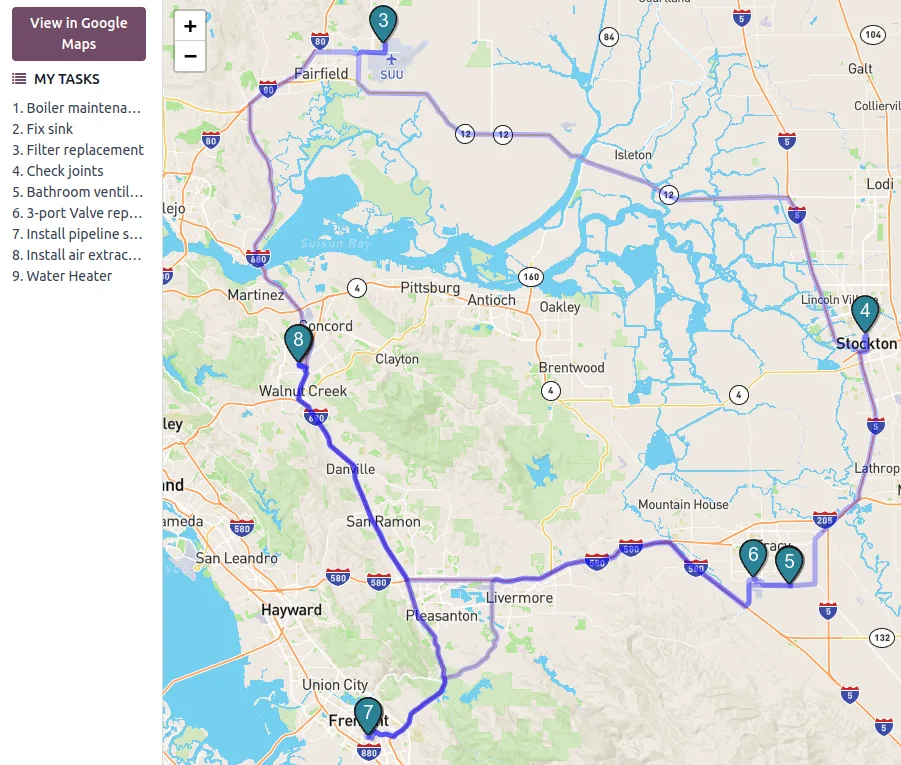
The daily view a cleaning operations manager uses to keep crews and clients on track.
Each platform we implement handles cleaning work well in a different situation.
| Business profile | Often a good fit | Why |
|---|---|---|
| Residential cleaning with online bookings | Zoho (Bookings, FSM, Books) | Customer-friendly booking pages, mobile field app and simple invoicing for high volumes of small jobs. |
| Mixed commercial contracts and home services | Odoo (Field Service, Sales, Inventory) | Recurring tasks, worksheets, stock issues and invoicing share one database and suit a growing operation. |
| Large contract cleaner with tight budgets | ERPNext | Maintenance schedules, stock, HR and payroll in an open-source package without per-user fees for supervisors. |
| Part of a wider services group | Dynamics 365 (Business Central with Field Service) | Suited to groups that need consolidated finance across several service companies. |
Booking apps and payment gateways are configured per platform during implementation.
Cleaning companies employ large teams and invoice many customers, so payroll and tax records need care.
Cleaning services are generally standard-rated at 5%. Residential customers still need a valid tax invoice or simplified invoice as applicable, and returns are filed through EmaraTax. Check specific cases with your tax advisor.
Cleaners on your visa must be paid through the Wage Protection System. ERP payroll produces the SIF file using attendance and overtime from scheduled shifts.
End-of-service gratuity and annual leave accruals follow Federal Decree-Law No. 33 of 2021. Accruing them monthly avoids a large unplanned cost when staff leave.
UAE e-invoicing through Accredited Service Providers is phased in from 2027 for business-to-business invoices. Contract clients will expect structured invoices; check the latest Ministry of Finance and FTA guidance on dates and scope.
General information, not tax or legal advice. Rules change; confirm current FTA, MOHRE and Ministry of Finance guidance with your advisor.
Outcomes depend on how consistently crews use the mobile app, but these are the usual goals.
Recurring schedules are generated automatically, and late jobs show up on the dashboard before the client calls.
Issues per site show which contracts are overusing chemicals and consumables against budget.
Completed and signed-off jobs flow straight to invoices, including extras added on site.
Real labour hours and material cost per site give you data to price renewals and new bids.
Typical ranges for a focused rollout; larger crews and multiple branches take longer.
Durations are typical ranges; your plan is agreed after discovery.
Document how bookings, contract visits, supplies issues and invoicing work today.
Set up services, price lists, recurring schedules, checklists, stock and payroll.
Run a few crews and contract sites on the mobile app to refine checklists and routes.
Move all crews and customers across, with supervisors trained in Arabic, English, Hindi or Urdu as needed.
Review consumption and margin reports and adjust pricing and schedules.
More on field service, facility and staffing ERP.
We configure the system for the rules UAE businesses report against, and test it before go-live.
General information, not tax or legal advice. Confirm current requirements with the FTA, MOHRE or your advisor. See all UAE compliance guides.
On-site workshops in Dubai, Abu Dhabi and Sharjah, and remote or on-site delivery across the Northern Emirates and free zones.
Official sources and references
Facts on this page were checked against these sources in October 2026. Rules change, so confirm current requirements before acting.
Still have a question? Our consultants are happy to help.
Ask an ExpertYes. We connect a booking page or form on your website to the ERP so the customer picks a service, date and property size. The booking becomes a scheduled job that the operations team assigns to a crew.
Each contract has a recurrence pattern, such as daily, three times a week or monthly deep cleans. The system creates the visits in advance and assigns them to the regular crew, while still letting you swap people when someone is on leave.
Yes. Supplies are issued from the store to a site or job, and the cost is recorded against that contract. You can set monthly allowances and get alerts when usage runs over.
Usually only supervisors or team leaders do. They open the job, complete the checklist, take photos and capture the client signature for the whole crew.
Yes. Contract customers get monthly consolidated invoices, while residential customers can pay by card link or cash on completion, with each receipt reconciled in accounting.
Related Solutions
Related Industries
Related ERP Platforms
Book a call with our Dubai team to map your cleaning operation onto the right ERP.
Dubai, United Arab Emirates