L
O
A
D
I
N
G


Zoho, Odoo, ERPNext, Dynamics 365 and custom ERP, delivered by one accountable team.

We help UAE factories choose between Business Central and Supply Chain Management, then configure BOMs, routings, MRP and lot tracking around how the shop floor really runs.
Dynamics 365 for manufacturing in the UAE means choosing between Business Central and Supply Chain Management. Business Central handles discrete manufacturing for single-site plants with production BOMs, routings, MRP and lot tracking. Supply Chain Management adds process manufacturing with formulas and co-products, quality orders and multi-plant master planning, suiting larger factories in areas such as KIZAD or Dubai Industrial City.
Dynamics 365 for manufacturing in the UAE covers two different products, and picking the right one is the first decision. Dynamics 365 Business Central includes production BOMs, routings, work and machine centers, production orders and a planning worksheet that runs MRP. Dynamics 365 Supply Chain Management goes further, with process manufacturing (formulas, co-products and by-products), lean and mixed-mode production, quality orders and master planning across several plants.
Most factories we meet in Dubai Industrial City, ICAD in Mussafah, KIZAD, Sharjah's industrial areas and Ajman run a mix of make-to-stock and make-to-order. A plastics converter may run standard SKUs on extruders while also taking custom print jobs. A food plant runs batches with expiry dates and allergen controls. A steel fabricator works job by job against drawings. Each needs a different setup inside the same ERP, and we design the production flow before we touch configuration.
As a Microsoft Partner based in Dubai, we implement Business Central for small and mid-sized plants and Supply Chain Management where multi-site planning or process manufacturing depth is needed. If you are still comparing platforms, our Odoo vs Dynamics 365 for manufacturing comparison sets out the trade-offs honestly.
These come up in discovery workshops whether the plant has 20 staff or 400.
Resin, steel coil, packaging film and food ingredients often arrive by sea from Asia or Europe through Jebel Ali or Khalifa Port. Without lead times in the planning engine, buyers either over-order or stop the line waiting for containers.
Landed cost, scrap, machine time and labor are often estimated in a spreadsheet once a year. Sales then quotes from a number that has drifted far from reality.
Customers in food, cosmetics and pharma ask which supplier lot went into a finished batch. If the answer depends on paper batch cards, a recall or audit becomes a week of digging.
Supervisors schedule by experience, and changes after a rush order are not recorded anywhere. Capacity conflicts surface only when the line is already late.
Plants that sell into the GCC, Africa and South Asia need certificates of origin, packing lists and correct VAT treatment on exports. Disconnected systems mean the same data is keyed three times.
A typical flow for a UAE manufacturer taking customer orders and buying imported inputs. Make-to-stock plants follow the same path with a forecast in place of the sales order.
One shared database: every step updates stock, finance and reports in real time.
Business Central covers most discrete plants. Supply Chain Management adds the process and multi-site depth listed in the last items.
Multi-level bills of material with versions, plus routings that carry setup and run times per work center. Engineering changes are dated so old orders keep their original recipe.
Calculates net requirements from sales orders, forecasts and safety stock. Buyers and planners accept suggestions as purchase or production orders.
Work and machine centers with calendars and efficiency. Load reports show where a week is overbooked before the shift starts.
Lot and serial numbers with expiry dates, captured on receipt, consumption and output. The item tracing page shows forward and backward genealogy.
Standard, FIFO or average costing per item, with material, capacity and overhead variances posted when a production order is finished.
For light kitting and assemble-to-order products that do not need a full routing. Useful for packing, gift sets and spare-part kits.
Supply Chain Management supports process manufacturing with formulas, potency, co-products and by-products. This suits chemicals, food and cosmetics plants.
Test groups and quality orders triggered at receipt, during production or before shipment. Failed lots can be blocked automatically.
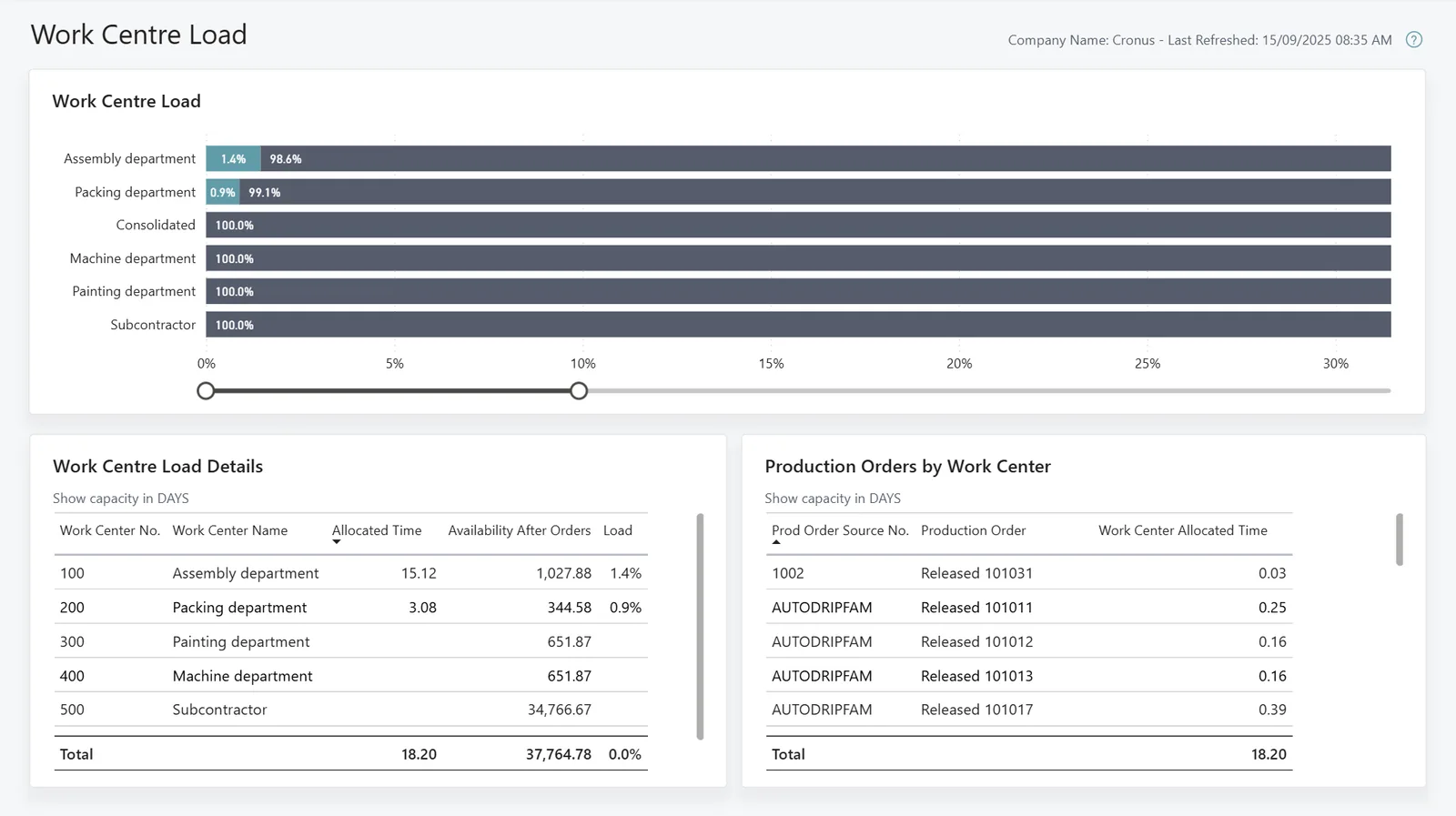
We build a role center for the production manager and a separate one for the plant accountant. Both read from the same posted entries, so the numbers agree.
We configure Dynamics 365 to support these requirements. Tax treatment depends on your facts, so confirm the details with your tax advisor.
Import VAT through reverse charge, zero-rated exports with evidence of export, and transactions inside VAT designated zones need separate VAT posting setups. We map each to the right box in the VAT return report.
Corporate tax at 9% applies above AED 375,000 of taxable income. A consistent costing method, documented write-downs and clean WIP figures make the tax computation easier to support.
Under Ministerial Decisions 243 and 244 of 2025, B2B invoices move to PINT AE through an Accredited Service Provider, mandatory from January 2027 for revenue of AED 50 million or more and July 2027 for others. Check the latest Ministry of Finance and FTA guidance.
Business Central does not include UAE payroll out of the box. We connect a WPS-capable payroll solution that produces the SIF file and posts salary and gratuity accruals to the ledger.
Posted entries cannot be deleted and change logs can be enabled on key tables. We set up an FTA Audit File export and keep records for the required retention period.
General information, not tax or legal advice. Rules change; confirm current FTA, MOHRE and Ministry of Finance guidance with your advisor.
Durations depend on product complexity and data quality. For a single plant on Business Central, the whole project often runs 12 to 20 weeks.
Durations are typical ranges; your plan is agreed after discovery.
We walk the floor, map each line, and document BOM structures, routings, costing method and traceability needs.
We confirm Business Central or Supply Chain Management and write the solution design, including any gaps and how to close them.
Items, BOMs, routings, work centers and vendor lead times are cleaned and loaded. This is usually the longest step.
We run one product family end to end, from MRP to shipment, and compare the calculated cost with the plant's own figures.
Planners, storekeepers, supervisors and accountants train on their own tasks. Opening stock and open orders are loaded at cut-over.
We stay close through the first month-end close and the first VAT quarter, then hand over to support.
More on platforms, modules and manufacturing sub-sectors.
We configure the system for the rules UAE businesses report against, and test it before go-live.
General information, not tax or legal advice. Confirm current requirements with the FTA, MOHRE or your advisor. See all UAE compliance guides.
On-site workshops in Dubai, Abu Dhabi and Sharjah, and remote or on-site delivery across the Northern Emirates and free zones.
Official sources and references
Facts on this page were checked against these sources in October 2026. Rules change, so confirm current requirements before acting.
Still have a question? Our consultants are happy to help.
Ask an ExpertBusiness Central handles discrete manufacturing well for single-site plants: BOMs, routings, MRP, capacity and lot tracking. Supply Chain Management makes sense for process manufacturing with formulas and co-products, several plants, or advanced quality and warehouse needs. We recommend one after a plant walk, not before.
Yes. Item tracking codes control lot, serial and expiry requirements per item, and the item tracing page shows which supplier lots went into which finished batches. Supply Chain Management adds batch attributes and quality orders for more regulated plants.
In Business Central, freight, customs duty and clearing charges are posted as item charges and assigned to the purchase receipt lines. The extra cost flows into the material value and then into production cost, so product costing reflects what the material really cost.
Yes. Output and consumption can be posted from production journals on a tablet, and barcode scanning is possible through mobile apps or extensions. For simple plants we often start with end-of-shift posting and add real-time capture later.
A single-plant Business Central rollout often takes 12 to 20 weeks. Multi-site Supply Chain Management projects are longer and are usually phased by plant. The main variable is how clean your BOM and routing data is at the start.
Related Solutions
Related Industries
Related ERP Platforms
Book a plant walk with our Dubai team and we will map your production flow before recommending Business Central or Supply Chain Management.
Dubai, United Arab Emirates