L
O
A
D
I
N
G


Zoho, Odoo, ERPNext, Dynamics 365 and custom ERP, delivered by one accountable team.

Automotive groups in the UAE often run sales, service, parts, accessories and fleet as separate silos. We design ERP that connects them under one group view.
A single ERP for automotive companies in the UAE can run vehicle sales, service, spare parts, accessories and leasing as separate companies or divisions with a consolidated group ledger. Intercompany sales post automatically on both sides, and brand, division, branch and emirate dimensions show profit across the group. A brand-mandated dealer system can be integrated rather than replaced.
ERP for automotive companies in the UAE has to serve a group, not a single shop. A typical mid-size automotive business might import vehicles, sell new and used cars, run a service center, distribute spare parts to independent garages, fit tinting and protection film, and lease vehicles to corporate clients. Each division has its own margins, staff and processes, yet the owners want a single answer to how the group performed last month.
In practice, divisions often grow with their own tools: a dealer system from the brand, a workshop program bought locally, a parts system inherited from an acquisition and accounting in a fourth application. Month-end then means exporting from each, adjusting intercompany transfers by hand and reconciling stock moved between divisions. The finance team spends its time stitching data together instead of analyzing it.
This page covers the group-level picture. For the detailed processes of each division, see our pages on car dealerships, auto workshops and auto parts trading.
These surface once an automotive company has more than one division or brand.
When the parts division supplies the workshop or the import company sells to the showroom, each side posts separately. Mismatches pile up and eliminations at consolidation become guesswork.
A fleet client may buy vehicles, service them in your workshop and order parts, yet each division sees only its own slice. Credit limits and relationships are managed in isolation.
Principals often expect periodic financial and operational reports in their own formats. Producing them from scattered systems takes days and invites errors.
Freight, insurance, customs duty and clearing charges must be allocated to each unit or part. Without this, gross margin by model or part family is unreliable.
Vehicle stock, parts inventory and unpaid fleet invoices all consume working capital. Leadership needs to see where cash is locked and which division is consuming it.
We map the internal supply chain so every handoff between divisions is recorded once.
One shared database: every step updates stock, finance and reports in real time.
These are the shared modules; division-specific tools sit on top or connect in.
Separate legal entities with their own TRNs and books, plus automatic intercompany entries and group consolidation.
Vehicles tracked by VIN, parts by part number and bin, accessories by SKU, each in its own warehouses.
Purchase orders to principals and suppliers with freight, duty and clearing costs allocated on receipt.
Retail leads, corporate fleet accounts and dealer-to-dealer sales managed with shared customer records.
Job cards, labor rates and parts consumption for the workshop, linked to the vehicle and customer history.
Vehicles leased to corporate clients with contracts, recurring invoices and depreciation.
Group dashboards by brand, division and branch drawn from one dataset.
Sales consultants' commissions, technician incentives and WPS payroll across entities.
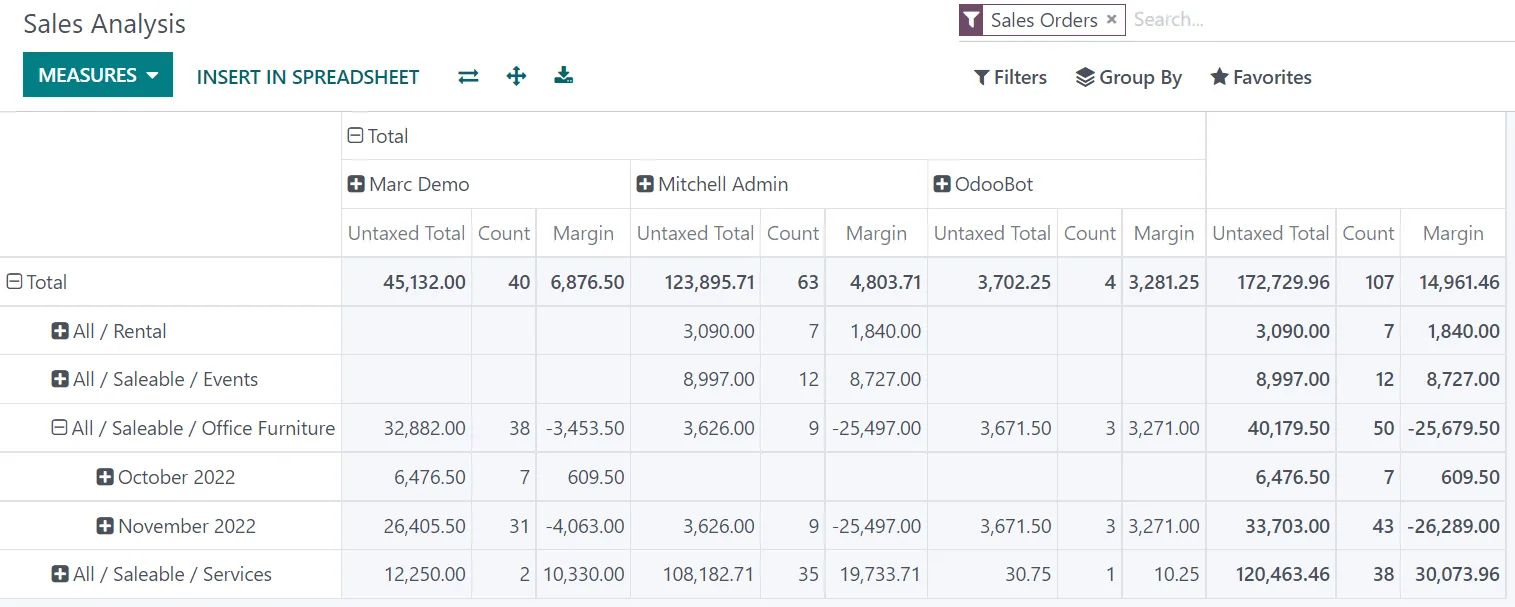
Owners and CFOs see every division side by side without waiting for month-end packs.
No platform is a full brand-approved dealer system out of the box, so we plan integration where needed.
| Company profile | Often a good fit | Why |
|---|---|---|
| Independent accessories, tinting or detailing chain | Zoho One or Odoo | POS, inventory, job tracking and accounting at a manageable cost across branches. |
| Multi-brand used car and service business | Odoo | Sales, repairs, inventory, fleet and accounting modules share one database with VIN tracking. |
| Parts importer and distributor | ERPNext or Odoo | Strong item master, multi-warehouse stock and landed cost for large catalogs. |
| Franchised group with several entities | Dynamics 365 Business Central | Multi-company consolidation and dimensions, with integration to brand dealer systems. |
| Group with unusual leasing or subscription models | Custom ERP alongside core accounting | Custom modules handle contract logic while the ledger stays standard. |
Where a vehicle brand mandates its own dealer management system, we integrate the ERP with it instead of replacing it.
We set the ERP up to support these rules. Confirm specific treatments with your tax advisor.
Standard-rated supplies are taxed at 5%, and each entity needs correct tax codes. Used vehicle sales may fall under special schemes, so tax settings per transaction type must be agreed with your advisor.
Duty paid on imported vehicles and parts should be captured on landed cost lines, with import VAT recorded for the return. Keep customs declarations linked to the receipt.
Each taxable person in the group calculates corporate tax at 9% above AED 375,000 of taxable income. Clean intercompany records support transfer pricing documentation.
B2B invoices, including fleet sales and parts to garages, move to PINT AE through an Accredited Service Provider from 2027. Check the latest Ministry of Finance and FTA guidance.
General information, not tax or legal advice. Rules change; confirm current FTA, MOHRE and Ministry of Finance guidance with your advisor.
We focus on these benefits; the actual gain depends on how fragmented things are today.
Group accounts and brand reports are produced from one ledger with intercompany eliminated.
Landed cost allocation shows the real cost of each vehicle and part family.
Aged vehicle and parts stock is visible early, so pricing and transfers can be adjusted.
Account managers see vehicle purchases, service visits and parts orders for each corporate client.
Groups usually go live one division at a time. Durations are typical ranges.
Durations are typical ranges; your plan is agreed after discovery.
Map entities, divisions, intercompany flows and existing brand systems.
Build the chart of accounts, dimensions, tax codes and consolidation rules.
Often parts or accessories first, as they have the clearest processes and highest transaction volume.
Workshop, vehicle sales and leasing follow, reusing the shared setup.
Dashboards and brand reports switched on once all divisions post to the ERP.
Division-level guides and the platforms behind them.
We configure the system for the rules UAE businesses report against, and test it before go-live.
General information, not tax or legal advice. Confirm current requirements with the FTA, MOHRE or your advisor. See all UAE compliance guides.
On-site workshops in Dubai, Abu Dhabi and Sharjah, and remote or on-site delivery across the Northern Emirates and free zones.
Official sources and references
Facts on this page were checked against these sources in October 2026. Rules change, so confirm current requirements before acting.
Still have a question? Our consultants are happy to help.
Ask an ExpertYes, with separate warehouses, price lists and dimensions for each division in one or several companies. Some groups still keep a brand-mandated dealer system for vehicle sales and connect it to the ERP for finance.
When one entity sells to another, the ERP can create the matching purchase on the other side automatically. Balances are then eliminated in consolidated reports.
Not necessarily. If the principal requires its own system, we integrate it so sales, stock and receivables flow into the group ledger.
Yes. Brand is set as a dimension or analytic account on sales, purchases and expenses, so every report can be filtered by it.
It depends on the number of divisions and entities. A phased rollout across several divisions often runs six to twelve months, with the first division live much sooner.
Usually the one with the clearest processes and most painful current system, often parts or accessories. Early success there builds confidence for the more complex divisions.
Related Solutions
Related Industries
Related ERP Platforms
Talk to us about a group-level ERP design that keeps each division efficient and gives you one set of numbers.
Dubai, United Arab Emirates