L
O
A
D
I
N
G


Zoho, Odoo, ERPNext, Dynamics 365 and custom ERP, delivered by one accountable team.

UAE traders buy in dollars, euros or yuan, pay freight and duty in dirhams, and sell across several pricelists. We configure Odoo so every cost lands on the right item and every sale shows its true margin.
Odoo for trading companies in the UAE shows the real margin per shipment after freight, customs duty, clearing and currency movement. Purchase orders can be raised in USD, EUR or CNY, receipts update stock, and Landed Costs spreads charges across items. Odoo converts to AED at the transaction-date rate and posts exchange differences, so pricing reflects landed cost, not supplier invoice cost.
Odoo for trading companies in the UAE is mostly about one number: the margin you actually made after freight, customs duty, clearing charges and currency movement. Many traders in Deira, Jebel Ali and Sharjah still calculate that figure in a spreadsheet after the goods have already been sold, which means pricing decisions are made on supplier invoice cost rather than landed cost.
Odoo handles the trading cycle in one database. Purchase orders can be raised in the supplier's currency, receipts update stock at the warehouse, and the Landed Costs feature in Inventory spreads freight, duty and handling across the received products by quantity, weight, volume or value. Sales then draw on that updated cost, so the margin on each invoice reflects what the goods really cost you.
We work with general traders, building materials suppliers, food importers, electronics distributors and re-exporters serving Africa, the Indian subcontinent and the GCC. The setup differs by product and route, but the core of every project is the same: correct costing, clean stock and pricing the sales team can follow. For a comparison with other platforms, see Odoo vs Zoho for trading companies.
The products we configure, integrate and support on projects like this one.
 Odoo Invoicing / Accounting
 Odoo Sales
 Odoo CRM
 Odoo Inventory
 Odoo Purchase
 Odoo Manufacturing
Product names and logos are trademarks of their respective owners and are shown only to identify the software we implement.
These are the patterns we see in import, wholesale and re-export businesses before they move to Odoo.
Freight and duty invoices arrive weeks after the goods. Without allocation, the sales team prices on the purchase price and margins are overstated.
Paying a USD or CNY supplier at a different rate from the invoice date creates exchange differences. When these are posted by hand, they are often missed or misclassified.
Goods sit in a mainland warehouse, a free zone bonded store and in transit on the water. Teams cannot see what is available to promise.
Wholesale, retail, export and key account prices live in different files. Salespeople quote from memory and discounts creep upward.
Traders often extend credit by habit. Without a limit check at order entry, overdue customers keep receiving goods.
Food, chemical and pharmaceutical traders need lot numbers and expiry dates for recalls and customer audits. Paper records make that slow and unreliable.
We configure each step so documents link to each other and costs follow the goods.
One shared database: every step updates stock, finance and reports in real time.
A trading setup leans heavily on Purchase, Inventory and Sales. Accounting ties them together.
RFQs, purchase orders in any currency, vendor price lists and blanket orders for agreed volumes with key suppliers.
Multi-warehouse stock, transit locations and landed cost allocation that updates product valuation.
Pricelists by customer group, currency, quantity break or date, with discount control and quotation templates.
Multi-currency journals, automatic exchange difference entries, credit limit warnings and receivables follow-up.
Track batches, expiry dates and serial numbers from receipt to customer, with traceability reports for recalls.
Scan receipts, picks and transfers on mobile devices so warehouse staff record movements as they happen.
Track enquiries from walk-in buyers, export agents and repeat customers, and convert them straight into quotations.
Sell goods that ship directly from supplier to customer without passing through your warehouse, still with the right cost and VAT.
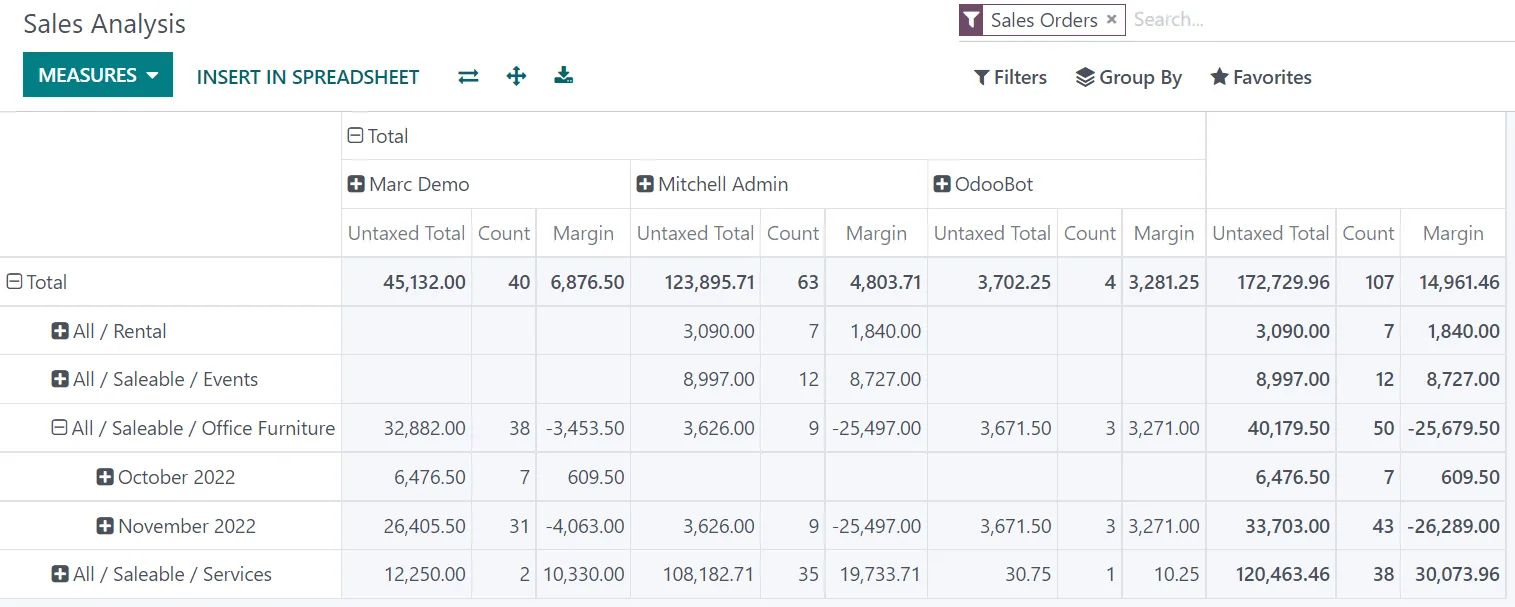
Trading managers check margin and stock availability more often than any other figures. We build one sales view around them.
Trading companies face more VAT scenarios than most businesses because of imports, exports and free zones. Odoo can support these treatments once configured, but confirm each one with your tax advisor.
VAT-registered importers generally account for import VAT through the VAT return rather than paying it upfront at customs. We set up Odoo tax codes so imports land in the right return boxes for review.
Exports of goods outside the GCC implementation states may be zero-rated when export evidence is kept. Odoo can tag export sales and attach shipping documents to the invoice.
Goods moved between designated free zones, or stored in bonded areas, can follow special VAT rules. We configure separate warehouses and tax positions so these transactions are easy to identify.
Most trading sales are business to business, so PINT AE e-invoicing through an Accredited Service Provider will apply from 1 January 2027 for businesses at AED 50 million revenue and above, and from 1 July 2027 for others. Check the latest Ministry of Finance and FTA guidance.
General information, not tax or legal advice. Rules change; confirm current FTA, MOHRE and Ministry of Finance guidance with your advisor.
Trading projects are usually shorter than manufacturing ones, but data cleanup on items and pricelists can take longer than expected. Ranges are typical, not guaranteed.
Durations are typical ranges; your plan is agreed after discovery.
Review of import routes, warehouses, pricing rules, currencies and current item master quality.
Warehouses, routes, landed cost types, pricelists, credit limits, tax positions and invoice layouts in Arabic and English.
Cleaning and loading the item master, units of measure, lots and opening stock at valued cost.
Buyers, storekeepers and salespeople run real shipments through the system before go-live.
Support through the first month, including a cycle count to confirm stock accuracy.
Go deeper on trading ERP, compare platforms or look at the Odoo apps traders use most.
We configure the system for the rules UAE businesses report against, and test it before go-live.
General information, not tax or legal advice. Confirm current requirements with the FTA, MOHRE or your advisor. See all UAE compliance guides.
On-site workshops in Dubai, Abu Dhabi and Sharjah, and remote or on-site delivery across the Northern Emirates and free zones.
Official sources and references
Facts on this page were checked against these sources in October 2026. Rules change, so confirm current requirements before acting.
Still have a question? Our consultants are happy to help.
Ask an ExpertYes. Landed cost entries can be created when the freight or duty bill arrives and linked to the original receipt. Odoo then adjusts the valuation of the items still in stock and posts the difference for items already sold.
Purchase orders and vendor bills can be in any active currency. Odoo converts them to AED at the rate on the transaction date and posts exchange gains or losses automatically when the payment rate differs.
Yes. Each warehouse can belong to the same or a different company in Odoo. Transfers between them can be set up as internal moves or as intercompany sales, depending on your legal structure and tax advice.
Yes. The quotation shows forecast availability per warehouse, and you can block confirmation if stock is insufficient or allow backorders, depending on your policy.
With lots and expiration dates enabled, Odoo records the batch and expiry date at receipt and can suggest picking by first-expiry-first-out. Traceability reports show which customers received a given lot.
Related Solutions
Related Industries
Related ERP Platforms
Send us one recent import with its supplier invoice, freight and duty bills, and we will show how Odoo would cost it.
Dubai, United Arab Emirates